

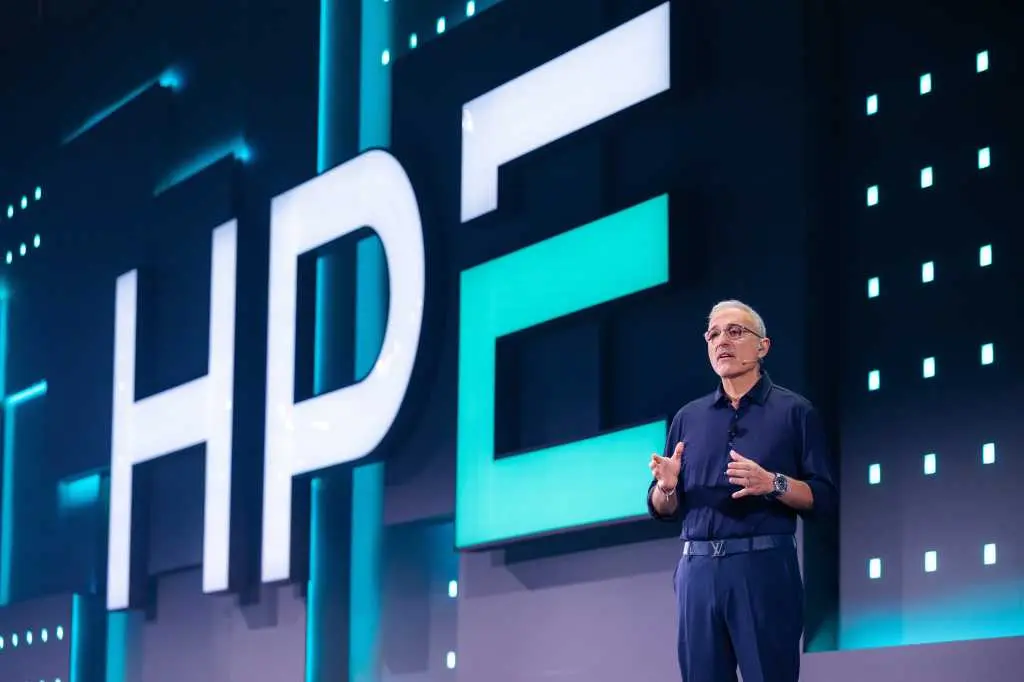
HPE’s AI-first vision takes center stage at Discover 2026
Hewlett Packard Enterprise (HPE) is making a bold bet that the future of enterprise IT belongs to AI agents. At HPE Discover 2026 in Las Vegas, CEO Antonio Neri delivered a keynote that framed the company’s entire product portfolio — from networking to compute, storage, and cloud — as a foundation for what he calls the “agentic enterprise.” The event brought together thousands of IT professionals, partners, and analysts, all eager to see how HPE is integrating its recent acquisition of Juniper Networks and evolving its AI strategy.
According to Neri, the shift is as transformative as the rise of cloud computing or the internet. “We are witnessing one of the largest technology platform shifts in history,” he said. “Workloads and applications are moving from being driven by end users to now being driven by both end users and AI agents.” This change demands infrastructure that can handle the unique requirements of autonomous agents: low latency, high throughput, scalable storage, and robust governance.
The network as the AI backbone
Neri placed networking at the core of AI success. “Every byte, every token, every decision, all of it crosses the network,” he argued. To that end, HPE announced a suite of new networking products that extend AI connectivity from GPU racks to the inference edge. These include the QFX switches for scale-up and scale-out workloads, the PTX 12,000 routing platform for data center interconnect with 800G capabilities, the SRX 4700 quantum-safe firewall delivering 1.44 Tbps throughput, and the MX 301 edge router built on Juniper’s sixth-generation Trio silicon.
The integration of Juniper technology, following the $14 billion acquisition completed in early 2025, is central to these announcements. HPE now offers a unified networking portfolio that combines Juniper’s high-performance routing with HPE’s Aruba and Mist AI-driven management. The new Marvis Actions feature, brought to Aruba Central and Aruba CX switching, promises automated troubleshooting and remediation for AI workloads.
Latency, Neri emphasized, is the invisible killer of AI performance. He illustrated the point with a simple arithmetic: “Multiply a small delay across hundreds of thousands of GPUs over weeks of training in your network can mean the difference between training a new model in 90 days or 30 days. It is the difference between chasing a breakthrough or making one.” The new networking infrastructure aims to minimize those delays, ensuring that data moves as fast as the algorithms require.
Scaling compute for agentic and long-context workloads
While the network provides the connective tissue, compute is where the work gets done. HPE organized its compute offerings into three AI Factory tiers: one for enterprises, one for service providers, and one for sovereign deployments. The centerpiece of the compute announcements is the new ProLiant DL 394 Gen 12 server, purpose-built for agentic AI and long-context workloads. These are tasks where agents must process extensive histories, such as legal document analysis, medical records review, or multi-turn conversational AI.
According to Neri, the AI Factory at Scale tier achieves a significant efficiency leap: requiring only one-quarter the GPUs of the prior Blackwell-generation platform for training, and delivering inference at one-tenth the cost per million tokens. Private Cloud AI configurations now scale to 256 GPUs with multi-node inference, allowing models to be served across multiple systems. A unified gateway provides a single API for accessing both frontier and open-source models, while a shared cache reduces the cost of computing the first token in a response.
“Private cloud AI can now serve larger models across multiple systems with multi node inference, so capacity grows with the math,” Neri said. This scalability is critical as enterprises move from experimental AI to production deployments where agentic workflows may need to handle thousands of concurrent requests.
Storage: unified, data-aware, and AI-ready
Agents are only as capable as the data behind them. HPE addressed this with the Alletra MPX 10,000, now serving as the default storage layer for Private Cloud AI. It unifies file and object storage on a single architecture, eliminating the silos that often slow down AI data pipelines. The platform adds real-time metadata enrichment and native support for the Model Context Protocol (MCP), enabling agents to retrieve data across both structured and unstructured sources without custom integration.
In his keynote, Neri highlighted the speed advantage: “Your AI agents are only as smart as the data you use to train them. Traditionally, that data required custom preparation for every use case and months of building the right AI data pipelines, but not anymore.” The Alletra MPX 10,000, validated by Nvidia as Certified Storage, claims a 7 to 12 times faster time to value compared to custom-built environments. This is achieved through automated data placement, compression, and quality-of-service policies that prioritize AI traffic.
Governance for the agentic enterprise
Perhaps the most forward-looking announcements came in the area of agentic operations. Neri acknowledged a growing pain point for IT leaders: AI agents are proliferating across organizations, often created by developers or business units outside formal IT oversight. This creates governance and security challenges that traditional IT management wasn’t designed to handle. “Agentic AI demands a new set of enterprise requirements,” he said.
HPE’s answer is a governed agent layer built into Private Cloud AI. Enterprises can register agents built in any framework — LangChain, Microsoft Semantics, or custom scripts — and apply security controls on API calls, identity, and encryption with zero code changes. A three-tier identity model verifies the user, governs the agent’s permissions, and requires human approval for sensitive actions such as deleting data or spending money. The system integrates with Nvidia Open Shell for isolated, policy-enforced agent runtimes, NeMo Cloud for governed workflow blueprints, and Zerto for clean-state rollback when an agent makes an error.
This approach allows organizations to embrace experimentation while maintaining control. IT teams can audit every action an agent takes, enforce cost limits, and kill runaway processes automatically. The agent governance layer is designed to scale from a handful of prototypes to thousands of production agents.
CloudOps and the partner ecosystem
Rounding out the announcements, HPE introduced CloudOps, a hybrid operating layer that consolidates virtualization, data protection, and cloud management into a single pane of glass. CloudOps sits on top of the AI infrastructure, providing IT teams with unified visibility and automation across on-premises, edge, and public cloud environments. Meanwhile, the Unleash AI program has expanded to include more than 60 validated partners, offering pre-built integrations for everything from data ingestion to model serving.
The partner ecosystem is a key differentiator for HPE. Unlike pure-play AI startups, HPE can provide a complete stack — from silicon to software — along with global support and financing. The company’s GreenLake platform offers as-a-service consumption models that let enterprises scale AI without large upfront capital expenditures.
The power problem lurking behind AI growth
Throughout his keynote, Neri also sounded a warning about the energy demands of AI. “Every model, every workload, every agent depends on power, because at its core, an AI factory is doing one thing: turning electrons into tokens,” he said. He cited data that the United States faces a 19-gigawatt power gap by 2028, with data centers projected to account for nearly half of U.S. electricity demand through 2031.
To address this, HPE is investing in liquid cooling, high-efficiency power supplies, and software-level optimization that reduces the energy cost per inference. The ProLiant DL 394 Gen 12, for example, supports direct liquid cooling to handle the thermal density of 256-GPU clusters. Neri emphasized that the future will not be defined by compute alone, but by how efficiently we can power, cool, and connect it.
HPE is also working with energy providers and government agencies to locate AI factories near renewable energy sources, part of a broader push to make AI sustainable at scale. The company’s own internal AI operations already run on 100% renewable energy in several regions.
Real-world implications for enterprises
The announcements at HPE Discover 2026 reflect a mature and pragmatic approach to enterprise AI. Rather than chasing the latest foundation models, HPE is focusing on the infrastructure layer that makes AI deployments reliable, governable, and cost-effective. For IT leaders, the message is clear: start preparing your network and storage for agentic workloads now, because the speed of AI adoption will only accelerate.
The integration of Juniper technology gives HPE a credible networking story in the data center, which competes directly with Cisco and Arista. The unified storage platform addresses a common bottleneck for AI teams, which often spend months wrestling with data formats and access patterns. And the agentic governance layer speaks directly to the anxiety many IT leaders feel about losing control to shadow AI projects.
As Neri concluded his keynote, he returned to the theme of partnership. “No single company can deliver the AI future alone,” he said. “It requires an ecosystem of innovators, builders, and operators working together to turn ambition into outcome.” With the product lineup unveiled at Discover 2026, HPE is positioning itself as the platform of choice for that collaborative future.
Source:Network World News