

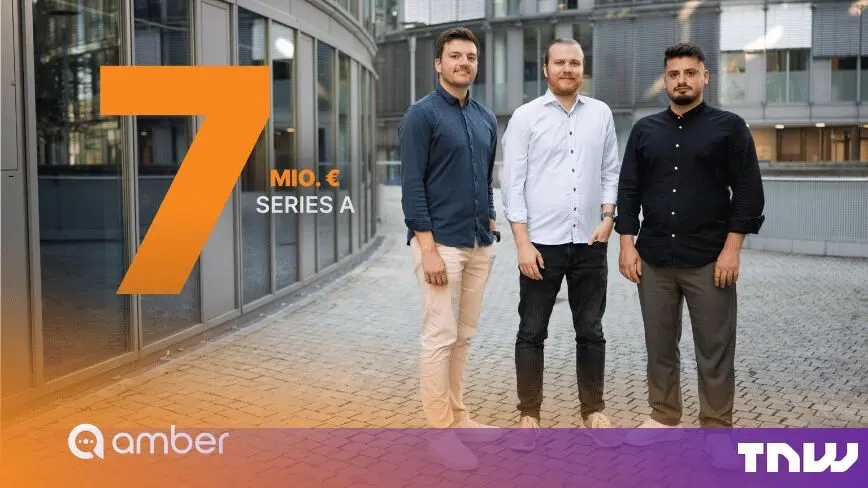
Aachen-based amber has closed a €7mn Series A round led by Ventech and NRW.Venture, the venture arm of NRW.BANK, the development bank owned by the German state of North Rhine-Westphalia. The round is modest by the standards of this year's AI deals, but the reasoning behind it is significant. amber's pitch is that the competitive battlefield in artificial intelligence has shifted from model architecture to the data that feeds it, and that European companies need a sovereign infrastructure layer to control that data.
Why data preparation matters more than models
amber builds what it calls an AI Data Layer. The idea is straightforward: before a large language model can deliver useful answers, a company's internal information — emails, documents, cloud apps, and business systems — must be collected, cleaned, structured, and made accessible. amber's technology does that connecting and structuring work, and the company's own funding announcement makes clear that this is where the new capital will be deployed.
Co-founder and chief executive Philipp Reißel argues that the industry has reached a point where model quality is no longer the deciding factor. “The competition for models is more or less over. The quality of responses depends on the context you ingest,” Reißel said. In other words, two companies using the same frontier model will get very different results if one feeds it organised, relevant context and the other does not.
amber attaches a concrete number to that argument. The company says structuring data before it reaches a model can cut token costs by as much as 60%, depending on the use case. That figure is amber's own and has not been independently audited, and the company itself hedges it with a use-case caveat. But the direction of travel is increasingly accepted across the industry. Uber's technology chief said this month that the era of tokenmaxxing — burning as many tokens as possible on model calls — is ending. Microsoft has reportedly told its own staff to stop wasting tokens. If frontier models continue to converge in capability, the economic value shifts to the companies that prepare the input.
A bet against the Cloud Act
amber's sovereignty pitch is an explicit part of the product. The company runs on German cloud infrastructure and has no American shareholders. It says that structure places it outside the US Cloud Act, a law that allows American authorities to compel US companies to hand over data wherever in the world that data is stored.
Co-founder Bastian Maiworm framed the company's identity in political terms. “What's happening at amber is decided by European minds,” Maiworm said. That line is aimed squarely at two American rivals. Glean, the Palo Alto company active in the same enterprise-search-and-knowledge space, reached a $7.2bn valuation last year. Microsoft, meanwhile, is merging its various Copilot offerings into a single enterprise product. Both companies are deeply integrated into the American legal and cloud ecosystem.
The sovereignty argument is gaining traction in Europe. Airbus recently shifted its most critical applications to a French cloud provider, a highly visible sign that large European companies are thinking about jurisdiction. Yet the EU's own “Made in EU” procurement rules do not mention software, leaving a policy gap. amber is selling directly into that gap rather than waiting for regulators to close it.
Compliance is a second layer of the same pitch. amber promises GDPR-compliant access to internal organisational knowledge, and for a German manufacturer, that can matter more than a benchmark score. Privacy and legal predictability are purchase criteria in the Mittelstand, not abstract ideals.
Who is paying: Mittelstand names and a demographic problem
amber's customer list reads like a cross-section of German mid-sized industry. Ritter Sport makes chocolate. Zentis makes jam. Hailo makes ladders. Scheidt & Bachmann builds fare collection and fuelling systems. Schüßler-Plan does engineering consultancy, and Dalli makes detergents.
These are Mittelstand firms, and they share a problem that is at least as demographic as it is technological. A generation of engineers, plant managers, and technical specialists is retiring, and much of their knowledge was never written down. It lives in experience, in ad-hoc decisions, in the habit of a maintenance routine. When those people leave, the knowledge leaves with them.
“It's quite difficult with large IT infrastructures to ensure that, once people retire, their knowledge remains accessible,” Maiworm said. That sentence captures the practical value of an AI data layer. If a company can capture, structure, and make searchable the accumulated knowledge of its most experienced people, the retirement wave becomes less threatening. amber promises to catch that knowledge on its way out the door.
The company now reports more than 400 active customers and a team of roughly 60 staff spread across Aachen, Cologne, and Tirana.
From search to assistants to agents
amber was founded in 2021 by Reißel, Maiworm, and Igli Manaj. All three have ties to RWTH Aachen University. Reißel and Manaj had worked on the underlying retrieval and knowledge-management technology before transformer models went mainstream. Maiworm brought the operator's perspective from a family business, which gives the company a clear sense of what industrial and commercial users actually need.
The product line has evolved as the market has evolved. It now runs as amberSearch, amberAI, and amberAgents, a naming structure that traces the journey from enterprise search to AI-powered assistance to autonomous agents. The next step is also the hardest. Most current AI tools still wait for a user to formulate the right question. amber wants to build software that recognises what needs to be done and does it without waiting for instruction.
“Today's AI tools are still waiting for users to ask the right questions,” Maiworm said in the funding announcement. That aspiration is common across the agentic AI wave, but it carries particular weight in an industrial context where the user is not a software engineer and where the cost of a wrong question can be measured in production downtime.
Public money and the governance problem
NRW.Venture is not a typical venture capital firm, and its involvement signals a broader European pattern. Public institutions are increasingly appearing on startup cap tables, either through direct investment or through state-backed funds. When the EU itself became a shareholder in a recent large AI raise, the scale was three orders of magnitude larger than amber's, but the instinct was the same: European strategic technology should have European capital behind it.
Johanna Antonie Tjaden-Schulte of NRW.BANK's managing board put it plainly: “Through our investment, we are supporting a start-up from North Rhine-Westphalia that is addressing a large European market and helping to strengthen the long-term competitiveness of SMEs.”
Ventech first backed amber in March 2025 with a €2.1mn investment and has now doubled down. Partner Nicolas Barthalon identified a third problem that amber helps solve. Beyond data preparation and sovereignty, large organisations are struggling to govern the proliferation of AI tools. Every department buys its own solution, nobody can see the whole estate, and the person responsible for governance has no map. Barthalon described this as accelerating AI sprawl, a complaint that is becoming familiar inside large companies.
What the money buys — and what it does not
It would be wrong to interpret this round as a direct challenge to Glean. A company with a $7.2bn valuation and a company with a €7mn round are not competing in the same commercial weight class, even if their product capabilities overlap. amber is contesting a segment — German-speaking, mid-market, industrial — rather than the entire enterprise AI market.
There is also a real cost to amber's choice to refuse American shareholders. It helps in conversations with Mittelstand boards that worry about the Cloud Act, and it makes the sovereignty message credible. But it narrows the pool of available capital at the very moment when American competitors are raising hundreds of millions of dollars. That is a deliberate trade-off, not an accidental one.
The founding claim remains contested as well. Frontier labs keep releasing models with measurable capability gains on benchmarks, which is not the pattern you would expect if the model competition were truly over. amber may be right that context engineering is the bigger commercial prize, but the underlying model race has not completely ended.
amber's stated expansion plan is to move into Benelux first, then the Nordics. The test will be whether a manufacturer in Antwerp or Helsinki cares as much about jurisdictional control as a manufacturer in Düsseldorf does. If sovereignty travels, €7mn will turn out to have bought a very cheap entry into a much larger market. If it does not, amber has still built an excellent German business.