

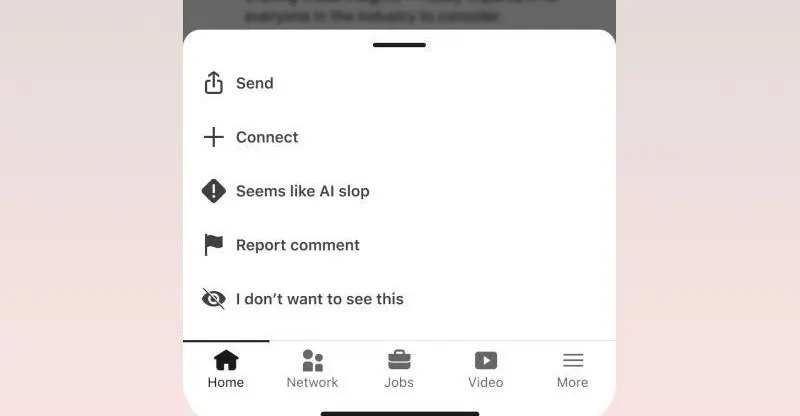
LinkedIn says its “Seems like AI slop” button has been used by more than one million people since the feature went live in late July. Chief product officer Hari Srinivasan shared the news in a post on Thursday, saying that the feedback tool had become one of the company’s most visible content moderation experiments. The button is available inside the three-dot menu on each LinkedIn post and lets a reader classify a piece of content as likely AI-generated. It is part of LinkedIn’s broader attempt to reduce the amount of machine-written material flooding professional feeds.
The phrase “AI slop” has become a widely used shorthand for low-quality, repetitive, and unnecessarily polished text created with large language models. On LinkedIn, such posts often share generic career advice, boilerplate leadership lessons, or vague inspirational messages, and they are frequently written in a style that is easy to spot. Some users have compared the feed to a stream of robot-authored motivational posters. LinkedIn’s decision to embrace the term directly, rather than relying on euphemisms such as “inauthentic content,” was surprising and generated a good deal of attention when the feature was first announced.
What the button does
The button works by giving readers an additional option when they open the overflow menu on a post. If the user sees something that feels as if it was written by an AI system, they can tap “Seems like AI slop” and the signal is sent back to LinkedIn. The company has not said exactly how each click is weighted or whether a single click is enough to lower a post’s distribution. Instead, the feedback is likely combined with automated classifiers and user reports to produce a more holistic picture of where AI-generated text is showing up in the feed.
Because the button sits inside the three-dot menu, people have to go beyond simply scrolling to use it. That makes the one-million-click milestone more notable: it suggests that a meaningful share of LinkedIn’s users are willing to actively flag content. LinkedIn has not revealed the total number of impressions or the platform’s daily active users in the same post, but a million clicks still indicates that AI-generated posts have become a central concern for the network.
Why LinkedIn is targetting AI-generated posts
LinkedIn has a special reason to worry about AI-generated content. The site’s core promise is to help professionals network, build their personal brands, discover relevant job opportunities, and engage with thoughtful commentary about their industries. If the feed becomes mostly automated filler, that promise erodes. Users may lose trust in the skill and insight shared on the platform, and they may start to ignore notifications or abandon the service altogether.
Before the button was announced, LinkedIn had already seen evidence of a serious AI-slop problem. The AI detector company Pangram found that 41 percent of LinkedIn’s longform posts were flagged as fully AI generated. The finding, which drew widespread coverage in early July, intensified pressure on LinkedIn to act. Shortly afterward, the company said it would introduce better classifiers to detect AI content and that it would remove the feature that allowed users to “enhance your post” with AI. The removal of that enhancement feature was notable because LinkedIn had originally positioned it as a convenience for people who wanted to polish their drafts or find better wording.
At the time, Srinivasan said, “AI slop is a top priority for all of us.” In the same announcement, he said LinkedIn wanted to build options that give people more control over the content they see. The AI slop button was the clearest example of that user-centered approach.
Early signals: Less reach for AI slop
In his Thursday update, Srinivasan said the platform has been making progress in reducing the reach of content it classifies as AI slop. LinkedIn now says users are seeing 40 percent fewer views of AI-slop posts compared with just a few weeks ago. That is important because engagement metrics such as views have a direct effect on how much content is distributed through the feed. A sharp reduction suggests the combination of user feedback, classifiers, and algorithmic changes is moving the needle.
LinkedIn is also adding a warning message for authors. A person who creates a post may now see a note saying, “Some members told us this post seems like AI.” This appears to be a soft nudge rather than a hard punishment. Srinivasan characterized the feature as helpful feedback and stressed that LinkedIn wants to assume good intent. “I know I’m increasingly conscious on how to not sound like AI & the goal is to provide helpful feedback,” he wrote.
The new message could make creators more cautious about the way they write. Some may change their language, break up their paragraphs, or insert more personal specifics to make their content sound authentic. Others might think twice before using an AI writing assistant to generate an entire post. For LinkedIn, the warning is a way to shift author behavior without resorting to outright bans.
The challenge of defining AI slop
Although the button is easy to use, the underlying classification problem is complicated. Not all AI-generated content is obviously low quality. A writer may use an AI tool to help brainstorm or edit a post while still adding original insights. In those cases, the final text may not be a verbatim chatbot excerpt, but it may still have a generic tone that feels synthetic.
There is also the question of false positives. If a human author writes a particularly polished post about leadership, ambition, or remote work, it could resemble the kind of language commonly generated by AI. LinkedIn says it approached the issue with good intent, suggesting it is aware that some mistakes are inevitable. The new author-facing note, framed as a helpful tip rather than a final verdict, gives people a chance to respond without feeling attacked.
Additionally, people might use the button in ways that are not purely altruistic. Competitors, unhappy colleagues, or users with opposing views could flag content simply because they do not want it to perform well. LinkedIn has not explained how it protects against coordinated or malicious flagging. The platform’s reference to classifiers suggests that human feedback may be weighted alongside automated signals to reduce abuse.
LinkedIn’s broader content quality efforts
The AI slop button is just one part of a larger push. Earlier this year, LinkedIn said it would take action against people who create comments “at scale with little or no human involvement.” The company did not want comment sections to be filled with empty, algorithm-boosting phrases such as “Great post!” or “Thanks for sharing!” generated by automated tools. That kind of comment spam had become increasingly common, particularly on high-visibility posts from executives and companies.
LinkedIn has also emphasized authenticity in its official guidance for members. The company encourages people to share their own experiences, lessons, and expertise rather than recycled motivational text. New tools, including the AI slop button, reinforce that message. By making it possible for users to tell LinkedIn when something feels inauthentic, the platform is hoping to collect the kind of context that purely technical systems cannot easily capture.
Across the technology industry, companies are trying different approaches to synthetic media. Some platforms label AI-generated images and video, while others use downranking to reduce the spread of suspected spam. LinkedIn’s button is unusual because it invites users to pass judgment on style and perceived origin. That may be more practical than trying to identify every image watermark or exact technical signature.
Pressure on authors and next steps
The new author message will probably become a familiar sight for people who use LinkedIn to publish high-volume thought-leadership content. If such a message shows up on a post shortly after publication, an author may feel pressure to delete the post or rewrite it. If it appears later, after a post has already gone viral, it may matter less. LinkedIn has not explained the timing, frequency, or threshold for showing the note.
Since the company says it is assuming good intent, it is unlikely to show the message after any single click. The system probably needs to see a pattern of feedback before it tells an author that members thought the post seemed like AI. That approach would reduce the chance of an unfair or random flag.
LinkedIn has not said whether repeated warnings could eventually lead to more serious enforcement, reduced distribution, or the removal of posting privileges. For now, the company’s message seems to be focused on education and improvement: it wants authors to understand how their writing may be perceived before they publish another similar post. The goal, as Srinivasan put it, is to offer helpful feedback that makes people more mindful of how their content comes across.
Whether LinkedIn will use these signals to limit distribution broadly is still unclear. What is clear is that the company has made AI slop a central part of its content moderation conversation. Srinivasan’s announcement repeats the promise that the goal is to provide helpful feedback, and LinkedIn is betting users will keep telling it what looks fake.
Source:The Verge News