

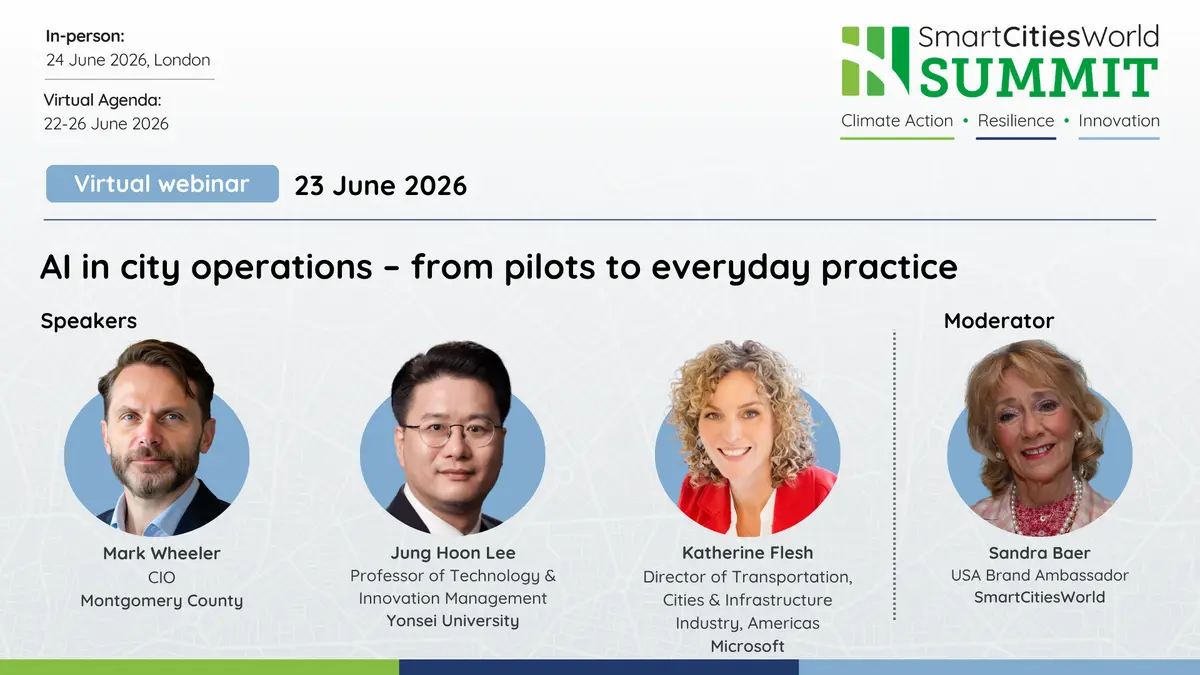
For local authorities around the world, the question is no longer whether artificial intelligence can improve city operations but how to move from pilots to everyday practice. The conversation is shifting towards practical implementation: how AI can strengthen workforce decision-making, how it can be embedded in infrastructure and services, and how cities can avoid the gap between experimentation and scale.
In a recent virtual panel discussion, experts argued that the key lies in combining unified data, agentic AI and secure digital foundations. Agentic AI refers to systems that can take goal-oriented actions with some degree of autonomy, guided by clear policy boundaries and human oversight. When connected to the right data infrastructure, such systems can help city staff sift through complex information, identify emerging risks, allocate resources and respond far more quickly to changes on the ground.
From pilots to sustained practice
Pilots have demonstrated the potential of AI in everything from traffic management to public service delivery. Yet progress has been uneven. A common obstacle is fragmentation: initiatives developed in one department often cannot draw on data held elsewhere. Without shared foundations, the promise of AI remains locked into discrete projects. According to experts in the panel, cities that succeed will be those that treat AI as part of a whole-system operating model rather than as a collection of standalone tools.
The shift to everyday practice also requires attention to governance. Decision-makers must understand what AI can and cannot do, how data quality influences outcomes, and which safeguards are necessary to protect privacy and public trust. Successful cities are developing frameworks that allow innovations to be tested rapidly while remaining subject to clear oversight. This is especially important when AI is used to support decisions with significant consequences, such as infrastructure investment, emergency response or the allocation of public services.
A strategic, risk-based approach
Resilience is another crucial theme. In a related virtual session preparing for a 2026 summit, participants considered how cities can move towards a more strategic, risk-based approach to infrastructure resilience. This means using data to understand where systems are most vulnerable, what the likely consequences of failure are, and which investments generate the most protection. It also means viewing digital infrastructure as an essential component of urban resilience, not simply as a technical add-on.
Risk-based approaches are particularly useful when budgets are constrained and demand for renewal is high. Rather than spreading limited resources thinly across all assets, cities can use data to identify the assets that carry the greatest operational weight. AI can assist by analysing sensor networks, maintenance logs, weather data and usage patterns in real time. When paired with secure digital foundations, these insights allow city managers to shift from reactive repairs to preventive maintenance.
The conversation around AI and operations is therefore expanding beyond individual use cases. City leaders are beginning to ask how data can flow across departments, how AI can support frontline teams, and how robust technical standards can speed adoption without creating new risks. The answers to these questions will determine whether AI becomes an everyday tool for civic problem-solving or remains a collection of promising demonstrations.
Sunderland: turning digital ambition into impact
Some cities are already demonstrating what sustained progress looks like. Sunderland's smart city programme is delivering measurable economic, social and public-service benefits. New research into the city's journey shows that long-term connectivity investment, civic leadership and trusted partnerships are turning digital ambition into real impact.
Sunderland has worked to reposition itself as a leading smart city, using digital infrastructure and low-carbon innovation to build a resilient, future-focused economy. The lessons from Sunderland are not limited to technology choices. They also include governance, community engagement and the ability to keep projects aligned with wider social and environmental goals. Other cities can learn from its approach to building partnerships across the public, private and academic sectors.
Cayala and Singapore: different pathways to urban intelligence
Different models are also emerging in newly built districts and established city-states. Juan Carlos Lopez, CTO and Chief of the Value Management Office at Cayala, has explained how agile transformation, digital infrastructure and community-led services are supporting the expansion of one of Central America's largest private cities. Cayala's experience shows that a private city can act as a testing environment for new operating models, while still prioritising the needs and wellbeing of residents and businesses.
In contrast, Singapore continues to build its reputation as one of the smartest nations in the world. The island city-state has long used data and digital technology to guide urban planning, transport, housing and environmental management. Singapore's approach is characterised by strong central coordination, advanced sensing networks and a clear set of national strategies for AI. The next stage of its journey will likely involve deeper integration across public-facing services and greater use of predictive analytics to anticipate the needs of citizens.
The emerging AI super gap between cities
Professor Jung Hoon Lee has also explored how AI is moving from pilots to real-world impact in cities worldwide. In an in-depth conversation, he discussed the latest Global Smart City Index and the emerging “AI super gap” between cities. This gap refers to the widening distance between urban areas that can make use of AI platforms and those that cannot.
Professor Lee argues that the next phase of urban innovation depends on data platforms, AI-ready infrastructure and effective governance. Cities that invest in these foundations will be able to adapt to new technologies more easily. Others risk falling behind, not because their technical teams lack skill, but because they lack the institutional conditions needed to bring innovations from lab to city street. The closing of the AI super gap will therefore require political will, sustained investment and continued exchange of ideas between cities.
Cybersecurity must be built into smart infrastructure
The expansion of connected systems also brings renewed attention to security. Fabio Mauri, Head of Technology Operations and Cybersecurity at Paradox Engineering, has highlighted why cybersecurity must be built into smart lighting infrastructure. Smart lighting is often one of the first connected systems installed in a city, but it is also one of the most widely distributed. Every light controller and sensor node is a potential entry point into a municipal network.
Embedding security from the beginning reduces vulnerabilities and helps protect the connected systems and services that modern cities increasingly rely on. This requires a clear understanding of how lighting infrastructure links to transport, public safety and building management systems. City managers should treat cybersecurity as part of the broader product lifecycle, from procurement and installation to maintenance and eventual replacement.
Transport AI and the value of workforce readiness
As transport agencies turn to AI to improve services, the greatest opportunities will depend on strong data foundations, workforce readiness and responsible governance. Katherine Flesh of Microsoft has put the point directly: these enabling factors matter more than any single algorithm. Transport data can be used to predict congestion, optimise transit routes and support long-term investment decisions, but only if it is accurate, accessible and used with care.
Transport officers also need new skills and clear protocols. Without workforce readiness, AI outputs may be ignored, misunderstood or used in ways that create unintended consequences. Responsible governance provides the guardrails that make AI a genuinely useful partner for public decision-makers. This is one of the most practical lessons for any city aiming to translate its transport pilot projects into dependable daily operations.
A wider frontier of urban value
The same themes are emerging across other parts of the urban landscape. An on-demand session on the energy transition considers how cities can move from being energy consumers to system leaders, managing decentralised generation, storage and flexible demand. Another discussion explores how to unlock value in cities from buildings, data and AI, including the potential to improve energy performance and occupant comfort through connected building systems.
Buildings are among the largest consumers of energy in any city, and they generate enormous volumes of data. Until recently, much of that data was left unused. Now, with secure platforms and AI-enabled analysis, building owners and city authorities can identify inefficiencies, reduce carbon emissions and create better environments for people. These possibilities reinforce the central message emerging from the latest city conversations: AI is becoming a normal part of everyday urban management, and its success depends less on technology alone than on the people, partnerships and governance structures around it.
Source:Smart Cities World News