

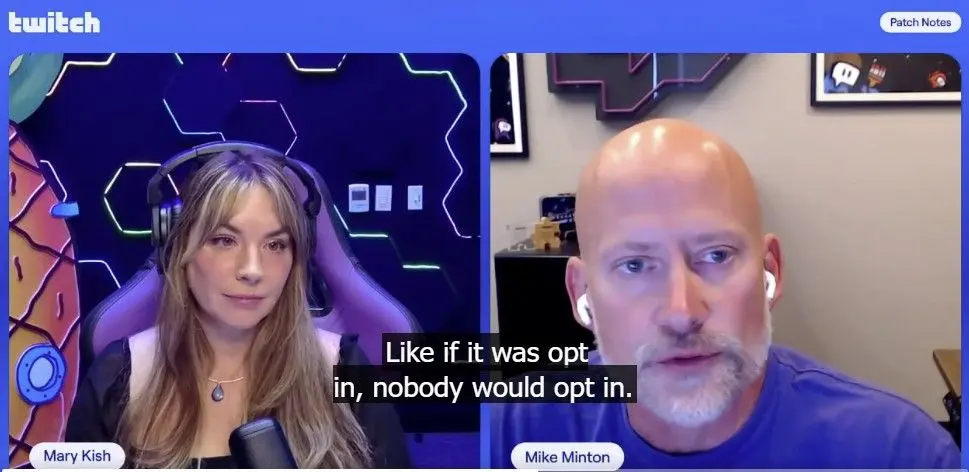
Twitch has found itself at the center of yet another user backlash, this time over the platform's decision to train artificial intelligence on content uploaded by its users. During a public discussion, Twitch's Chief Product Officer appeared to acknowledge that the company knew the policy would be deeply unpopular. “If it was opt in ... nobody would opt-in,” he said, admitting that the opt-out system was chosen at least in part because it would guarantee more participation. The comment immediately drew fire from streamers and viewers, who called it a rare moment of honesty about how platforms treat user data.
At issue is Twitch's new AI training feature, which by default allows the platform to use broadcasts, chat messages, and other user-generated material to train machine-learning models. Twitch has framed this as a way to improve moderation, recommendation systems, and future creative tools. But for many creators, the feature feels like a violation of trust. They point out that streaming often involves copyrighted music in the background, private conversations, and hours of intimate interaction with audience members. Allowing AI to absorb that content without clear permission creates serious privacy and legal concerns.
A Misguided Defense
The CPO's remark seemed intended to justify the default-enrollment approach, but it had the opposite effect. Instead of reassuring users, it confirmed that the platform expected resistance if it had offered a meaningful choice. One could argue the comment was a slip of the tongue, but it aligned with what critics have been saying since the announcement: the only way to get enough users into the AI training program is to make it impossible to avoid.
The admission is especially damaging because Twitch has spent years telling its community that it values transparency. Streamers have built careers on the platform, and many have invested thousands of hours into their channels. To see the company treat their content as raw material for AI models without asking first is disheartening. One prominent streamer wrote that the quote would be used in future discussions about corporate power and AI, because it so clearly exposes the logic behind default adoption of intrusive systems.
Why The Feature Frightens Creators
There are several reasons why Twitch's AI training move has caused such an intense reaction. First is the issue of consent. Opt-out systems make participation the default, forcing users to locate buried settings and actively remove themselves. Many will not bother or will not know it exists. Research on privacy and human behavior has repeatedly shown that defaults matter enormously; people tend to stick with whatever option is preselected. Twitch's CPO essentially admitted that the company relied on this inertia.
Second is the nature of Twitch content. It is not just text or still images. It includes video, voice, and often the likeness of the streamer. This is deeply personal data. Artificial intelligence technology is now capable of cloning voices and producing realistic deepfakes. If a streamer's content is used to train an AI system, there is genuinely no telling how that data might be used in the future. Even if the current feature is benign, future applications could be harmful.
Third is the financial dimension. Creators already contribute enormous value to Twitch through content that attracts advertising revenue and subscriptions. Now they are also expected to contribute free data to help build Twitch's AI products. Many argue that if the company is going to profit from AI training, the creators whose data powers the models should be compensated or at least asked for consent. The CPO's quote suggests that asking would result in a collective no, which only strengthens the argument that the feature should be cancelled or redesigned.
Among the most common concerns raised by the community are:
- The use of VODs and clips without explicit permission.
- The inclusion of chat messages, which are often assumed to be ephemeral.
- The potential for AI features to replace human creators or devalue their work.
- The lack of clarity regarding retention and deletion policies.
- The possibility that copyrighted music or third-party content will inadvertently be ingested.
A Pattern Of Trust Erosion
This is not the first time Twitch has faced a credibility crisis. In 2020, the platform was hit with a wave of DMCA takedowns that caught many streamers off guard, leading to panic as old clips were deleted and channels faced strikes. In 2021, a series of hate raids exposed serious flaws in moderation systems, forcing Twitch to implement emergency measures. There have also been ongoing complaints about discoverability, payout structures, and the way major policy changes are communicated.
Each incident has chipped away at the trust between the platform and its creators. The AI training controversy fits into that pattern. Twitch announces a product decision, the community reacts with alarm, and Twitch responds defensively before eventually offering vague promises to do better. This time, however, the CPO's words made it impossible to frame the feature as a misunderstanding. He admitted that users would reject it if they had a choice, and that admission has become the story.
Some commentators have pointed out that the quote should not be surprising. In the broader tech industry, the default has often been to use customer data for AI training unless the customer opts out. Social media platforms, photo services, and even healthcare systems have made similar choices. But Twitch is different because of the intimate and creative nature of its content. Streamers are not anonymous uploaders; they are performers with public identities. Their work is their livelihood.
Is An Opt-In Model Really Impossible?
The CPO's statement also raises a practical question: would an opt-in model really fail? Twitch has one of the most engaged user bases on the internet. Many audiences actively support creators through subscriptions, donations, and fan communities. It is entirely possible that a meaningful number of users would voluntarily share data if the benefits were clear and if they were offered something in return. The problem is that Twitch did not try. It skipped the invitation and simply enrolled everyone, leaving them to find the exit sign.
An opt-in approach could have been framed as a partnership. Twitch could have explained that helping to improve moderation tools or AI-generated highlights would make the lives of streamers easier. It could have offered early access to new features as a reward for participation. Instead, the company chose the path of least resistance and then found itself defending an unpopular policy.
Moreover, the CPO's justification ignores the possibility of allowing users to choose at different levels. Some creators might be comfortable having their VODs used for AI training but not their chat logs. Others might agree to contribute to specific research projects but not to commercial AI products. A well-designed consent framework could offer granular control. The current system, by contrast, treats users as a uniform block of training data.
The controversy also brings up issues of regulatory compliance. Laws such as the General Data Protection Regulation in Europe give individuals certain rights over their personal data. It is not clear whether Twitch's default enrollment approach would stand up under objections from European users or from regulators in other jurisdictions. If a streamer officially requests that their data be removed from an AI training set, the platform may be forced to comply. That could be a painful process that would have been much easier to avoid with upfront consent.
What This Means For Twitch's Future
Twitch faces a difficult path forward. The company must either redesign the feature to be genuinely opt-in, or it must try to reassure users that the opt-out process is simple and painless. Neither option is easy at this point. A redesign would look like a capitulation, but it would also demonstrate that Twitch listens to its community. Keeping the current model would likely prolong the backlash and damage retention among some of the platform's most active users.
The irony is that the feature was probably created with moderation and recommendations in mind. AI systems need massive amounts of data to work effectively, and Twitch arguably needs good AI to solve problems like combatting hate raids and surfacing high-quality content. If Twitch had taken the time to build trust before rolling out the data collection, the community might have been more receptive. Instead, the feature has become a symbol of corporate indifference.
For many streamers, the decision to stay on Twitch is no longer automatic. Competitors have made attempts to attract creators with more favorable revenue splits and promises of greater creative freedom. The AI training controversy gives streamers one more reason to consider alternatives. The fact that a high-ranking executive openly said that users would not choose to participate is a devastating indirect criticism of the feature itself.
Perhaps the most telling part of the whole episode is that the CPO did not appear to be defending the policy with confidence. The original title of the article captured the moment by describing a high-level executive squirming under public pressure. That image is powerful because it suggests that even those responsible for the decision know it is wrong. The phrase “If it was opt in ... nobody would opt-in” may go down as one of the most self-damning statements made by a technology executive. It tells users what they already suspected: their consent is less important than the data they produce.
Twitch now has to decide whether it wants to continue down this path or begin rebuilding trust. The community has made its position clear. The CPO's own words prove that he understood the risk. Whether Twitch uses that understanding to change course, or simply to refine its messaging, will determine how this chapter in the platform's history is remembered. What remains certain is that the company can no longer pretend that the anger is driven by a misunderstanding. The users hate the feature, and now the executive responsible for it has admitted why.
Source:Windows Central News