

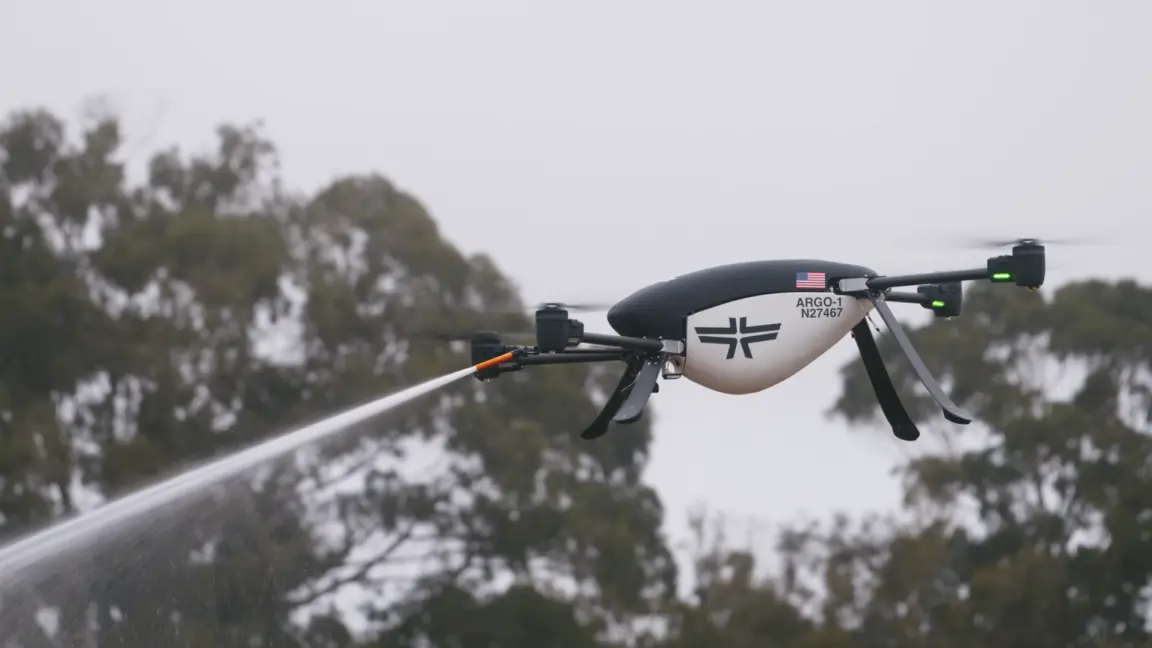
Drones capable of spraying water and fire retardants have been practicing how to snuff out wildfires early in California and Alaska this summer—demonstrating a possible rapid-response tool for firefighting as climate change transforms wildfire season into a nearly year-round risk for much of the United States.
Most drones are significantly smaller than crewed aircraft and have shorter flight ranges, meaning they cannot replace large airtankers in delivering massive payloads of water or other fire-suppressing payloads to remote wildfires. But companies and fire agencies—along with organizers of the $11 million XPRIZE competition—are testing whether drones can help firefighting crews respond more quickly to small fires and put them out before they become more destructive.
The California Department of Forestry and Fire Protection, also known as CAL FIRE, ran its own field test involving five autonomous drones that worked together to deploy between 500 and 1,000 gallons of foam combined for suppressing fires on July 15, according to the TV station KPMH. The demonstration was organized with the help of the nonprofit FireWERX and the California-based company Seneca, which is making the drones commercially available starting in 2026.
Each of Seneca’s Argo-1 drones can carry about 100 pounds of water or fire retardant while working together in swarms of four to six drones. Once a human operator uploads a GPS waypoint, the autonomous drones fly toward their target and use onboard sensors to spot the heat signature of a fire, HeliOps Magazine reported. The drones then find the best hovering altitude before each lining up to spray the fire, one after the other.
The fully loaded drones are limited to a round trip of 10 miles while flying at about 30 miles per hour on average, which means they would ideally need to be prepositioned in fire-prone areas or first transported by ground vehicle. But each drone can fit in the back of a pickup truck with the tailgate down, and two people can even manually carry the empty drones.
Seneca told HeliOps Magazine that the goal is to enable firefighters to refill a returning drone’s payload and swap in a fresh battery so that it’s ready to fly again in two minutes. The company previously demonstrated its drone technology for San Bernardino County Fire in December 2025.
Testing in the Alaskan wilderness
Separately, the XPRIZE Wildfire competition gave another firefighting drone system its own trial by fire in finals testing just outside of Fairbanks, Alaska in June 2026. The Silvaguard autonomous firefighting drone system—developed by the German company Dryad Networks—worked with the Dryad’s Silvanet wildfire detection network to autonomously detect and suppress a wildfire within the competition’s 1,000 square kilometer test area.
Dryad’s detection system consists of solar-powered sensors attached to trees that are designed to detect the smoke from a smoldering fire. When a sensor triggers the alarm via a wireless mesh network to an Internet-connected border gateway device, a prepositioned Silvaguard observation drone launches to confirm and geolocate the fire using infrared and optical imaging sensors, while also ensuring that it’s not a false alarm.
That sets the stage for a Silvaguard suppression drone to take off and deploy up to 26 gallons of fire suppressant onto the fire. The drones can be prepositioned inside solar-powered, spherical hangar pods.
The ultimate test for whether Dryad’s system or Seneca’s drones can nip fires in the bud will come if fire agencies deploy them during the lengthening wildfire season. The Aspen Fire Protection District in Colorado has become an early customer by already committing to a $5 million contract for deploying five of Seneca’s drones over five years.
CAL FIRE has not signed up any firefighting drones just yet, but it represents another large potential customer. The California fire agency already operates the world’s largest aerial firefighting fleet with more than 70 crewed fixed-wing aircraft and helicopters, along with using AI-powered camera networks and supporting development of the FireSat constellation designed to spot wildfires from space even faster.
Wildfires have become an increasingly persistent threat across the United States, with the average annual burn area more than doubling over the past two decades compared to the 1990s. Climate change has intensified drought conditions, raised temperatures, and extended the traditional fire season. In California alone, the state has witnessed some of its most destructive blazes in recent years, including the Camp Fire of 2018 and the Dixie Fire of 2021. These megafires have prompted fire agencies to seek new technologies that can detect and suppress ignitions before they escalate into infernos.
Drones offer a unique advantage in this effort: they can be positioned close to high-risk areas and launched quickly without requiring a human pilot. While crewed aircraft like airtankers and helicopters are essential for large-scale suppression, they are expensive to operate and can be grounded by poor visibility or hazardous conditions. Small drones, by contrast, can operate in more confined airspace and provide a lower-cost supplement to traditional firefighting fleets. The Autonomous systems being developed by Seneca and Dryad Networks aim to eliminate the need for a dedicated pilot for every mission, allowing a single operator to oversee multiple drones simultaneously.
The Seneca Argo-1 drone is designed specifically for tactical firefighting. Its 100-pound payload capacity is modest when compared to the thousands of gallons carried by airtankers, but the concept of using swarms means that multiple drones can combine their efforts. In the CAL FIRE test, five drones worked in coordination to lay down a continuous stream of foam across a simulated fire line. This kind of synchronized attack could be especially valuable for knocking down spot fires that threaten to jump control lines or for cooling down hot spots after a larger aircraft has made a drop.
Dryad Networks, which is better known for its wildfire detection sensors, has expanded into suppression with its Silvaguard drone. The company has deployed more than 20,000 Silvanet sensors in forests across Europe and North America over the past few years. These sensors are designed to detect the unique chemical signatures of smoke, providing an early warning that can precede satellite detection by several hours. By linking the sensors directly to an autonomous drone system, Dryad has created an end-to-end response pipeline that can operate in remote areas without human intervention.
The XPRIZE Wildfire competition, which launched in 2022 with an $11 million purse, was created specifically to accelerate the development of such technologies. The Alaska finals tested systems in realistic conditions, challenging teams to detect and suppress fires across a vast, rugged landscape. Dryad's Silvaguard system successfully demonstrated that it could identify a fire and deploy a suppressant payload within minutes, a feat that would be difficult for traditional ground crews to match in such terrain.
The growing interest from fire agencies is a strong signal that drones are moving from experimental gadgets to operational tools. The Aspen Fire Protection District’s $5 million contract represents one of the first large-scale commitments by a local fire agency to deploy autonomous drones. Over five years, the district plans to integrate the drones into its existing fire response protocols, using them for both prevention and early suppression in the wildfire-prone Rocky Mountains.
While drones are unlikely to fully replace crewed aircraft, they are poised to become an essential layer in the nation's firefighting arsenal. As the technology matures, improvements in battery life, payload capacity, and flight range will expand their capabilities further. The ultimate goal, according to developers, is to create a network of sensors and drones that can catch 90% of fires before they grow larger than a few acres. Given the escalating wildfire crisis across the United States, that goal is more urgent than ever.
Source:Ars Technica News