

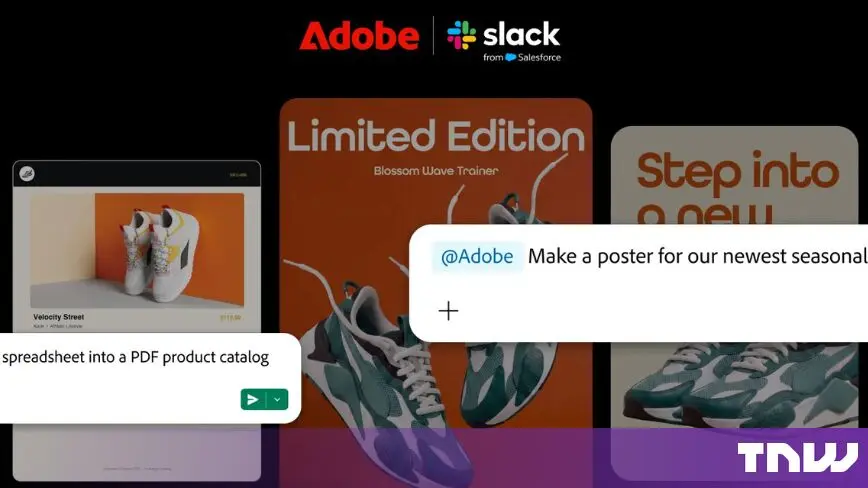
Adobe has officially launched Adobe for Slack, a deep integration that places its pro-grade creative and productivity tools directly inside Slack channels. With this new offering, Slackbot can route a prompt to Firefly, Photoshop, Premiere, or Acrobat and return the resulting file without leaving the collaboration platform. The integration is designed to help teams create, refine, and share content in real time, wherever conversations are already taking place.
The timing is significant. With the EU AI Act's Article 50 now requiring synthetic content to be marked in a machine-readable format, Adobe is positioning itself as a key player in the provenance landscape. The company co-authored C2PA, the standard behind Content Credentials, and the European Commission has explicitly named C2PA as an example that meets transparency requirements. By embedding AI-powered creation tools into Slack, Adobe is bringing these capabilities into everyday workflows—and into the center of a growing regulatory conversation about AI-generated media.
How Adobe for Slack Works
At its core, Adobe for Slack is about reducing friction between the tools teams use to communicate and the tools they use to create. Once the integration is installed, Slackbot acts as a bridge. A user can simply type a prompt in a channel, and Slackbot interprets that request based on context pulled from the conversation history, canvases, and shared files. It can also search a Creative Cloud library by subject, style, or mood, making it possible to locate brand assets without leaving Slack.
The range of tools connected to the integration is notable. Adobe says that more than 70 of its tools are available through the Slack integration, including flagship applications like Photoshop and Premiere, as well as Acrobat for document workflows. This means that generating a PDF from a chat discussion, editing an image with Firefly, or even assembling a short video clip can all be done through a simple chat interaction.
Importantly, Adobe for Slack is designed to read the channel to understand what is being asked. This context-aware approach helps ensure that the generated output aligns with the intent of the conversation. For example, if a team is discussing a marketing campaign and asks Slackbot to create an image with a specific mood, the tool can use the surrounding discussion and any referenced files to inform the generation.
Teams can then review and iterate on assets directly inside channels. This is a major efficiency gain, as it eliminates the need to switch between applications or share files back and forth. Instead, all stakeholders can see the creative process unfold in real time, provide feedback, and request changes without losing the thread of the conversation.
Availability and Pricing
One important caveat is that Adobe for Slack is not included in standard Adobe Creative Cloud or Slack subscriptions. To use the integration, organizations need to be on a Slack Business+ or Enterprise+ plan, and they must also have a separate Adobe subscription. This dual-subscription requirement means that the tool is aimed primarily at businesses that already rely heavily on both platforms and are looking for a more streamlined workflow.
The pricing structure could be a barrier for smaller teams or solo creators, but for enterprises that already invest heavily in creative software and collaboration tools, the added value may justify the cost. By bringing the two ecosystems together, Adobe is betting that the convenience of in-chat creation will be worth the extra expense.
Part of a Broader Integration Strategy
Adobe for Slack is not the only integration of its kind. Adobe has been actively embedding its AI capabilities into other chatbot and assistant platforms. Last month, Adobe announced a similar integration for ChatGPT, giving users of that platform access to Firefly and other creative tools. There is also already a version for Anthropic's Claude, and Adobe has promised a Gemini integration in the near future.
This multi-platform strategy suggests that Adobe sees AI-powered creation as something that should live wherever users are already working, rather than forcing users to come to a separate creative application. By partnering with major chatbot providers and collaboration platforms, Adobe is extending its reach and making its tools more accessible to a wider audience.
From a competitive standpoint, this is a smart move. Microsoft and Google have been pushing their own AI capabilities in productivity software, and OpenAI has been adding image generation to ChatGPT. Adobe's strength lies in its deep, professional-grade tools, and by making them available through chat interfaces, the company is differentiating itself from competitors that offer only lightweight or limited creative features.
The EU AI Act and the Provenance Challenge
The launch of Adobe for Slack comes at a critical moment for AI regulation in Europe. Since August 2, 2026, Article 50 of the EU AI Act has required synthetic images, video, and audio to be marked in a machine-readable format. This means that any AI-generated media must carry provenance data that can be read by machines, allowing people to verify whether something was made by AI or by a human.
Adobe is arguably better positioned than almost any other company to help organizations comply with this requirement. Adobe founded the Content Authenticity Initiative and co-authored C2PA, which is the provenance standard behind Content Credentials. Content Credentials can embed information such as the name of the creator, the tools used, and whether AI was involved in the creation process. This information is designed to be tamper-evident and to survive format conversion, at least when handled by C2PA-aware tools.
The European Commission has effectively endorsed C2PA. The Commission's transparency code explicitly lists C2PA as an example that meets all four of its criteria for provenance marking. Those criteria include robustness, meaning that the marking must survive format conversion and minor edits, as well as be tamper-evident to the extent technically feasible. It also requires interoperability, so that different platforms and tools can read and understand the provenance data.
Adobe's integration with Slack is therefore not just a convenience play—it is also a way to bring provenance-aware creation into a widely used communication platform. When a team generates an image or video inside Slack via Firefly or Premiere, the output should include Content Credentials that mark it as AI-generated, in line with the EU AI Act.
Open Questions About Provenance in Chat Platforms
Still, there are open questions about whether Content Credentials survive the specific pipeline of Slack. For example, if a user generates an asset in Slack, downloads it, and then drops it into a presentation deck, does the credential remain attached? The answer depends on how the file is processed during those steps. C2PA-aware tools will preserve manifests when they convert files, but a naive re-save—without any C2PA awareness—can strip the data.
This is a known challenge in the broader ecosystem. Adobe and other proponents of Content Credentials have acknowledged that not all software is C2PA-aware, and that simple actions like taking a screenshot or uploading to a social media platform may remove the provenance data. The EU AI Act language anticipates this issue by encouraging the pairing of C2PA with an invisible watermark. This is exactly what OpenAI has adopted in its image generator, DALL-E, alongside Google's SynthID for its generative media.
Others are addressing the problem from a different angle. YouTube, for example, now uses its own detection systems to label AI-generated video, even when the creator does not disclose it. This approach relies on inference rather than marking at the source, which can be less reliable but also less dependent on creators following the rules.
The Gap That Still Needs Attention
The Slack integration highlights a gap worth naming. Adobe helped write the standard, and it has made significant strides in embedding Content Credentials into its own tools. But no one has yet tested what a chat client like Slack does to those credentials when assets are generated, downloaded, and re-shared in a real-world workflow. The lack of a definitive answer is not necessarily a reason for alarm, but it does highlight the complexity of enforcing provenance across the entire lifecycle of a digital file.
As AI-generated content becomes more commonplace, trust and transparency will be essential. The EU AI Act is one of the first major legal frameworks to require machine-readable marking, and it is likely that other jurisdictions will follow. Companies that deploy AI tools will need to ensure that their workflows preserve provenance data, or they may run afoul of regulations.
Adobe for Slack is an ambitious step toward integrating creative AI into everyday collaboration. But it also serves as a reminder that the tools we use to create are only one piece of the puzzle. The broader challenge lies in building an ecosystem where provenance is respected, preserved, and understood—from the initial prompt in a chat thread all the way to a finished product that reaches the world.