
When generative AI first reached mainstream attention in early 2023, two capabilities captured user interest: long-form text generation and convincing artificial images. Since then, model quality has improved rapidly. By 2026, users can choose among an unusually crowded set of paid tools that promise photo-realistic output, reliable text rendering, restoration of old images, and playful cultural remixes.
This evaluation set out to find which AI image generator deserves a subscription. Six popular services were tested in four large categories: revising existing images, creating original artwork, adding readable text to images, and responding to pop-culture prompts. The results were not close.
Key takeaways
- Google's Nano Banana Pro, inside Gemini 3, earned a near-perfect 93%.
- ChatGPT finished second with 74%, well behind the leader.
- Midjourney, Adobe Firefly, Leonardo AI, and Canva scored between 43% and 57%.
- Nine demanding prompts separated serious tools from also-rans.
- Only one service seemed worth its monthly cost for reliable, broad-purpose image generation.
The testing process was more extensive than a quick visual comparison. The six generators were given the same nine prompts, each judged against a scoring rubric. Across all services, an aggregate score came from 30 individual evaluations. The test also covered more than 50 images. Important details: all images were generated in the same 1:1 square ratio so side-by-side comparisons were fair. The categories included three photo-related tasks, four creative tasks, and two text-heavy social prompts plus pop-culture challenges.
How the rankings were built
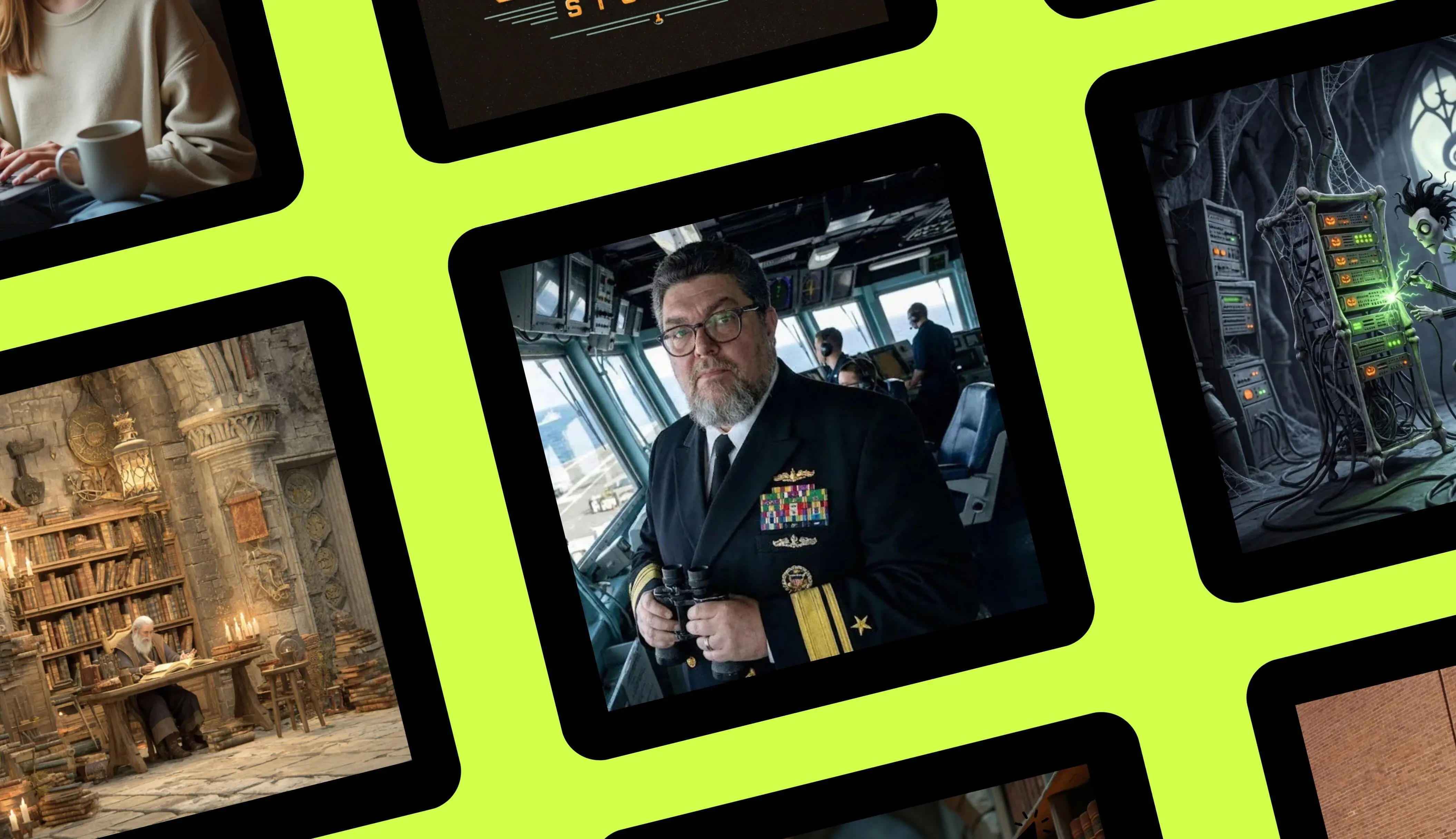
The first test asked each tool to take a casual photo of a man and dress him in a US Navy admiral's uniform on the bridge of an aircraft carrier, while keeping the face unchanged. The second test required restoration of a black-and-white photo, including scratch removal, clarity improvements, and preservation of facial features. The third combined restoration with colorization, using an old truck photo with lettering on the side. The fourth prompt was a logo for a fictional video studio called Space Coast Studios. The fifth requested a medieval librarian in a candlelit stone library.
Two social-media-style prompts demanded an image of a senior adult holding a smartphone and a student with a MacBook and coffee, both with readable advertising copy on the picture. The final two were cultural: a fictional fourth Back to the Future movie poster set in 1920s New York, and a Nightmare Before Christmas-style portrait of an IT professional in a data center.
Each response was scored on criteria specific to the prompt, including fidelity, readability, structural correctness, and whether the tool respected authorial constraints. For that reason, a beautiful image could still lose points if the tool failed to preserve a face, render text accurately, or clean up an old photo.
Winner by a knockout: Google Nano Banana Pro
Google's Nano Banana Pro, bundled with Gemini 3 as part of Google AI Pro, received a 93% aggregate score. It earned only minor deductions, and it did not fail a single category. The near-perfect result is rare in AI benchmarking; in past comparisons, no single product has so thoroughly outclassed the field.
Nano Banana Pro's best moments came in photo recontextualization. When given a source photo and asked to create an admiral portrait, it preserved the face and glasses, altered the facing direction, placed the figure in a plausible ship bridge, and added props such as binoculars. It also handled a dark childhood photograph, cleaning up the face and clothing while retaining the original period character.
The tool was not flawless. In one test, after working with a portrait, it confused a new request to restore an old truck image and produced the same portrait again, now colorized, with the subject wearing an admiral's uniform. The tester had to start a new session. In the truck restoration, most of the lettering was readable, but one word was rendered incorrectly as 'BADICLOGICAL DEFEKSE' rather than the original agency wording. The service also places an unobtrusive watermark at the bottom corner of each generated image, which may annoy users who want clean output for immediate use.
On creative prompts, Nano Banana Pro produced a usable Space Coast Studios logo with a palm tree and a rocket, a convincing candlelit medieval library, and cleanly rendered social media ad text. It even placed correct typography on a fictional movie poster and put a Marty McFly-inspired character in period clothing beside a recognizable DeLorean. Pop culture responses included a Tim Burton-esque IT figure and a strong grasp of the original film's visual language.
Runner-up: ChatGPT
OpenAI's ChatGPT image generator, now updated and available inside ChatGPT Plus, finished second with 74%. That distance is significant. ChatGPT still beats most rivals, but it fell 19 points behind Nano Banana Pro because of inconsistent photo editing and faltering pop culture output.
The ChatGPT admiral recontextualization kept the original face, but the uniform's rank insignia were muddled. The kid photograph restoration improved on older generations, but a previous version had inserted an unfamiliar adult face. The truck restoration changed the lettering from 'RADIOLOGICAL DEFENSE' to 'RADIO CHEMICAL DEFENSE.'
Social media posts were mostly clean, although the text tended to sit in the same spot and required strong contrast to remain readable. The tool did far better on logos and library scenes. The biggest problem was cultural prompts. In one test, it produced a generic refusal or a non-responsive object instead of something resembling the requested well-known intellectual properties. The earlier generation had performed better, producing a satisfying poster and a Nightmare-inflected technician with an extra hand. Under the current model, pop culture appearances appear unpredictable; users may see a strikingly accurate reference one moment and a strange refusal the next.
Midjourney
Midjourney Basic, at $10 per month, earned 57%. It continues to excel at cinematic and illustrated originals. The library scene was exactly evocative, and the Nightmare IT professional image was among the best in the study. For original fantasy work, Midjourney retains a devoted following.
It is far less reliable for realistic edits. The admiral test did not preserve the source person's face; the tool combined unrelated elements. Old photo cleanup was not effective, and the truck image produced a different truck with an inexplicable added person in the frame. It also frequently ignored text requirements or placed images onto a fixed canvas without adapting composition. In short: use Midjourney for imagination, not documentation.
Adobe Firefly
Adobe Firefly, built into Creative Cloud and offered via paid desktop apps, scored 54%. The test used the Firefly Image 5 preview model. Firefly is the safest choice for commercial use, but it is also the most restrictive. It refused an uploaded source image because the user's T-shirt contained a copyrighted graphic. The tool was especially sensitive to prompts containing '-style' phrasing, often blocking requests that referenced existing artist styles. It would not attempt the two pop culture prompts at all.
When Firefly did produce results, the kid photo cleanup was good, and the truck colorization looked vibrant. Still, restoration was incomplete; artifacts remained. The logo was strong, but some faces showed an uncanny valley effect. Text generation was inconsistent, including awkward spelling in the social media category. Adobe's safety-first behavior is understandable, yet it hurts a tool that asks to be taken seriously in highly creative tests.
Leonardo AI
Leonardo AI, priced at $10 monthly and also available through Canva's paid plans, got 52%. It completely declined to handle the image restoration tasks in this test, which removed any chance at a high score. In original creation, it produced a usable logo and a perfectly valid medieval librarian. One social media image showed the subject's elbow in an uncomfortable position, while another showed a coffee cup balanced on a leg in an unrealistic composition.
For fantasy art, Leonardo remains attractive. Its best single image was a photo-realistic, Lurch-like IT professional in a data center, combining a gothic character with modern server racks. It was imaginative and memorable. But the system did not meet the practical standard set by the winner.
Canva
Canva's internal generator trailed the field with 43%. It is integrated into layouts and marketing tools, and it has a low barrier to use, but the raw image quality is a serious limitation. Canva produced trees growing on the deck of an aircraft carrier, a missing truck in a truck restoration task, and a floating head above bizarre architecture. Some of its outputs were funny, and the logo test was clean, but larger failures outweighed those moments.
Canva did produce a Back to the Future-style poster with recognizable elements and legible logo text, but parts of the tagline were gibberish, the environment was wrong, and there was no consistent logic in what the tool allowed. It refused a second pop culture prompt while printing a copyrighted movie title in the first generation. For quick marketing layouts, Canva remains convenient; for high-quality AI image generation, it is now far behind the competition.
What this means for buyers
The result is unusual. In most AI model reviews, no single provider wins by this wide a margin. Nano Banana Pro's total score of 93% versus ChatGPT's 74%, and every other tool below 60%, makes the recommendation simple. If the goal is serious AI image generation across many use cases, the $20 subscription for Gemini 3 and Nano Banana Pro is now the obvious choice, and free tiers are unlikely to deliver comparable quality or stamina.
After two images, the tester was prompted to buy the paid plan to continue using Nano Banana Pro. That means free users will get a taste of the quality, but real workloads require the paid tier. The monthly cost is the same as ChatGPT Plus, so price alone does not explain the ranking.
For specialized needs, the rest of the field still has a place. Midjourney remains appealing for cinematic illustration. Adobe Firefly is useful when copyright concerns matter, although its safety filters can reject legitimate prompt phrasing. Leonardo AI is capable of fascinating fantasy and gothic imagery. Canva's convenience and design workflow are meaningful for social media managers. ChatGPT is a strong conversational partner with a capable editor, and its integration with chat makes iterative prompting easier.
Yet in this test, only one generator consistently handled photo restoration, readable text, accurate composition, and cultural references. Nano Banana Pro did not merely finish first; it demonstrated a different level of competence. The next step for rivals is to close the 19-point gap in reliability, text handling, and pop culture literacy.
Source:ZDNET News