

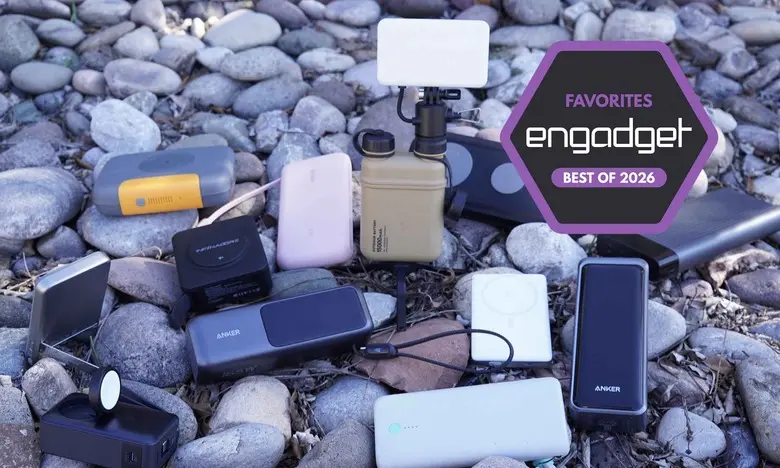
A dead phone can ruin a day, but a portable power bank removes that worry. We have tested dozens of batteries over several years, measuring real charging speeds, capacity, portability, durability and value. Below are the best power banks for 2026, from tiny emergency sticks to high-capacity laptop chargers.
Best power banks for 2026
Best MagSafe power bank: Anker MagGo Power Bank (10K)
The Anker MagGo Power Bank was one of the first Qi2-certified devices to ship, and the new wireless standard makes this MagSafe-style battery far faster than early magnetic packs. It has a 10,000mAh capacity, 15W wireless output, one USB-C in/out port, and a USB-C cable. In testing, it charged a nearly dead iPhone 15 to 50 percent in about 45 minutes. That is roughly three times faster than the previous generation. It still had enough power left for another charge, taking the phone to 70 percent.
- Capacity: 10,000mAh
- Maximum output: 15W wireless
- Ports: one USB-C in/out
- Weight: 8.82 oz
The built-in display shows the battery percentage and an estimate of time remaining. The magnetic hold is strong, so you can use the phone while it charges, and the kickstand props it up for video or StandBy mode. Qi2 also means Pixel 10 phones get 15W magnetic charging. The USB-C port makes the battery useful for non-Qi2 devices. The main downside is price: it costs more than many other MagSafe packs.
Pros
- Fast Qi2 wireless charging
- Sturdy kickstand
- Battery percentage display
Cons
- Pricier than rivals
Best portable charger for Android: Anker Nano Battery (Foldable USB-C)
The Anker Nano battery is shaped like a small lipstick case and has a built-in USB-C connector that folds when not in use. That means you never have to remember a cable or adapter. It packs 5,000mAh, delivers up to 22.5W, and has a second USB-C port for refilling the bank or charging another device. In our tests, it took a depleted Galaxy S23 Ultra to 65 percent in about an hour. It is small enough to use while walking and handy for earbuds too.
- Capacity: 5,000mAh
- Maximum output: 22.5W
- Ports: one USB-C and one USB-C connector
- Weight: 3.5 oz
For more power, Anker's 30W Nano Power Bank offers 10,000mAh and a display; its built-in USB-C cable doubles as a carry loop. The smaller Nano is affordable and extremely portable. Its only downside is that it is small enough to lose.
Pros
- Very portable
- Affordable
Cons
- Small enough to get misplaced
Best low-capacity power bank: Anker 10K Fusion
The Anker 10K Fusion solves common power bank annoyances with a built-in USB-C cable and foldable wall prongs. You can plug the battery straight into an outlet to recharge it, and use the attached cable for your phone. It has 10,000mAh capacity, 30W output, and an extra USB-C port. It took a Galaxy S23 Ultra from five percent to full in just over an hour, and an iPhone 15 from five to 45 percent in 20 minutes. The display gives an accurate remaining percentage. A previous favorite, the BioLite Charge 40 PD, remains a durable alternative, but the 10K Fusion delivers faster charging and more features for a lower price.
- Capacity: 10,000mAh
- Maximum output: 30W
- Ports: one USB-C in/out, one USB-C in/out cable, wall prongs
- Weight: 8.8 oz
Pros
- Built-in USB-C cable
- Built-in wall prongs
- Accurate display
- Affordable
Cons
- iPhone charging is slower than some rivals
Best medium-capacity power bank: Belkin BoostCharge 20K with Integrated Cable
The Belkin BoostCharge 20K has a built-in magnetized USB-C cable, plus one USB-A and one USB-C port. The 20,000mAh battery can charge a phone about three times. It outputs 30W, which is not the fastest, but it still charged a Galaxy S24 Ultra from empty to full in one hour and 15 minutes, and an iPhone 15 from five to 87 percent in just over an hour. It comes in black, blue, pink and white. The four indicator LEDs are accurate, though there is no digital percentage display.
- Capacity: 20,000mAh
- Maximum output: 30W
- Ports: one USB-C in/out cable, one USB-A port, one USB-C port
- Weight: 14 oz
Pros
- Handy built-in cable
- Four color options
- Great capacity for the price
Cons
- Charging is not the fastest
Best medium-high capacity power bank: Nimble Champ Pro
The Nimble Champ Pro delivers excellent speed for its price. It has a 20,000mAh capacity, 65W maximum output, and two USB-C in/out ports. It charged a Galaxy S23 Ultra from five percent to full in under an hour, and supplied nearly three full charges to an iPhone or Galaxy. It also refills from a wall outlet quickly. Nimble is a certified B Corp, and the Champ Pro is made from 90 percent post-consumer plastic. The marbled finish comes from recycled materials. The only issue is that the four indicator LEDs sometimes underestimated the remaining charge in early tests, though accuracy improved later.
- Capacity: 20,000mAh
- Maximum output: 65W
- Ports: two USB-C in/out
- Weight: 12.9 oz
Pros
- Super fast charging
- Made from recycled materials
- Sturdy and compact design
Cons
- Indicator lights underestimated charge
Best multi-device power bank: BioLite Charge 100 Max
The BioLite Charge 100 Max is compact and rounded for travel. It has a 25,000mAh capacity, 120W total output, four USB ports and a 15W MagSafe-compatible wireless pad. It delivered five iPhone 15 charges, four Galaxy S23 Ultra charges, more than two iPad Air charges, and a partial MacBook Pro charge. The rubberized texture and yellow accents make it stand out. BioLite is a climate neutral-certified B Corp that supports off-grid energy projects. The main drawback is price: it costs more than some similar-capacity rivals.
- Capacity: 25,000mAh
- Maximum total output: 120W
- Ports: wireless pad, two USB-C, one USB-A, one USB-C
- Weight: 1.28 lbs
Pros
- Compact and colorful design
- Charges phones, tablets and laptops quickly
- Climate neutral certified
Cons
- More expensive than similar-capacity batteries
Best laptop power bank: Anker Laptop Power Bank with Built-in Cable
This Anker bank includes two built-in USB-C cables, one attached as a carry handle and one retractable up to two feet. Both support input and output. It has a 25,000mAh capacity, 165W maximum output, a USB-A port and a USB-C port. The display shows remaining charge, output wattage and refill time. In testing, it refilled a MacBook Pro from near-dead to about 68 percent in 53 minutes, and a Galaxy S23 Ultra in 52 minutes. It costs only a little more than Anker's popular PowerCore bank but includes the cables. The screen is prone to smudges.
- Capacity: 25,000mAh
- Maximum output: 165W
- Ports: two USB-C in/out cables, one USB-A port, one USB-C port
- Weight: 1.31 lbs
Pros
- Two built-in USB-C cables
- Durable build
- Detailed display
- Fast charging
Cons
- Screen picks up smudges
Best premium power bank: Anker Prime Power Bank 26K 300W
The Anker Prime 26K 300W is one of the most powerful banks we have tested. It has 26,250mAh capacity, 300W combined output, two 140W USB-C ports and one 22.5W USB-A port. It charged an iPhone 15 from near-dead to 60 percent in 30 minutes and delivered more charge to a MacBook Pro than any other bank in our tests. The display shows remaining charge and battery temperature. It pairs with an app for detailed stats, though the built-in display already offers most of that information. The battery is sleek and compact, and an optional charging base adds convenience but costs extra. It is expensive, especially with the base.
- Capacity: 26,250mAh
- Maximum combined output: 300W
- Ports: two USB-C, one USB-A
- Weight: 1.32 lbs
Pros
- Super fast charging
- Sleek premium design
- Display shows charge and temperature
Cons
- Pricey, especially with optional base
Best power bank for outdoors: Nestout 15000mAh Outdoor Battery Power Bank
The Nestout battery has an IP67 rating, meaning it can survive being submerged in about one meter of water for up to 30 minutes. We dropped it in a bucket of water for five minutes and it continued to work perfectly after drying. Rubber gaskets and screw-on caps protect the ports. It also survived repeated drops from chest height. It has a 15,000mAh capacity, 32W maximum output, one USB-C in/out, one USB-C input and one USB-A output. Charging speeds are a little slower than some competitors, and the included cable is only seven inches long. Nestout sells a worklight, tripod and solar panel as accessories; the compact solar panel filled the battery to 40 percent in under three hours.
- Capacity: 15,000mAh
- Maximum output: 32W
- Ports: one USB-C in/out, one USB-C in, one USB-A
- Weight: 12.8 oz
Pros
- Waterproof with caps secured
- Clever accessories
- Survived drop tests
Cons
- Not the fastest charge times
- Included cable is short
What to look for in a portable battery pack
Battery type
Nearly every rechargeable power bank uses a lithium-ion battery. These offer a strong size-to-charge ratio and have become more energy-dense over time. They do not suffer from the memory effect that plagues older battery chemistries.
Flying with portable batteries
Because lithium-ion cells can overheat, airlines and regulators restrict them. The current rules allow external batteries rated at 100Wh or less to fly in carry-on baggage, not checked luggage. All of our picks meet that limit. Some airlines have added extra rules, such as keeping an active power bank in view while using it.
Capacity
Capacity is listed in milliamp hours (mAh). A 5,000mAh bank can top up a phone to around 50 to 75 percent. A 20,000mAh to 25,000mAh bank can recharge phones many times and often a laptop. Remember that efficiency is not 100 percent: in our tests, a 10,000mAh battery delivered roughly 5,800mAh to a phone; a 20,000mAh delivered about 11,250mAh; and a 25,000mAh delivered about 16,200mAh. Expect around 60 percent efficiency after voltage conversion and heat loss.
Wireless charging
Wireless charging is less efficient than wired, but it is convenient. Qi2-certified batteries support up to 15W and magnetic alignment. iPhones and Pixel 10 phones can use that standard. Newer Qi2 25W devices, including iPhone 17 and Pixel 10 Pro XL, are beginning to appear, and the first 25W batteries are arriving. For now, a Qi2 15W bank is a reliable choice for most phones.
Ports
USB-C delivers faster charging than USB-A, and most recommended banks have at least one USB-C port. Larger banks list different wattages per port, so check the labels. A 100W port can charge a phone quickly, but a 15W port will not do much for a laptop. Cables also have wattage limits, so use a cable that can handle the speed. Built-in USB-C cables are increasingly common and eliminate one item to remember.
Design
Power banks now come in many colors, shapes and finishes. Some add MagSafe compatibility, kickstands, wall plugs, displays or built-in cables. Most have indicator lights to show remaining charge. A digital display is more precise. Choose a design that fits how you travel and what you carry.
How we test power banks
We start by looking at established brands and customer reviews, then buy the most promising models and test them in real conditions. For each battery, we discharge a phone or laptop to between zero and five percent, then charge it using the power bank until the device is full or the bank dies. We test iPhones, Android phones, iPads and laptops depending on the battery's capacity. We also measure charge time, output wattage, physical size, build quality and extra features. We update this guide as new products are released.
Other power banks we tested
Belkin Stage PowerGrip
This 9,300mAh battery is also a Bluetooth camera-style shutter with a tripod thread. It magnetically attaches to iPhones and charges wirelessly, but its charging speed is slow; it took about two hours to get an iPhone 16 from three to 98 percent. It is useful for mobile photography.
Anker MagGo for Apple Watch power bank
This 10K battery has a pop-up Apple Watch charger and a built-in USB-C cable. It is a niche product, but it can keep your phone and watch alive while traveling.
HyperJuice 245W
Hyper's 27,000mAh brick is compact and attractive, with four USB-C ports. It charges a phone about four times and a MacBook Pro to 75 percent. The lack of USB-A and the price keep it from earning a top pick.
EcoFlow Rapid magnetic power bank
The first power bank from EcoFlow is a Qi2 magnetic 5,000mAh model with a fold-out stand and attached cable. It looks good but did not match the charging speed or capacity of our MagSafe pick.
Mophie Snap+ Powerstation Mini
This 5,000mAh magnetic battery is well built, but its capacity is too small for a full phone charge, and our top MagSafe pick offers twice the capacity for only $20 more.
Power bank FAQs
What's the difference between a portable power bank and a portable charger?
The terms are often used interchangeably. They all refer to a lithium-ion battery that stores energy and refills a phone, tablet, earbuds, laptop or other device. What matters is capacity, size, weight and ports. Power stations are different: they are large units that can power multiple appliances but cannot be flown.
Does fast charging ruin your battery?
Fast charging creates more heat, and heat is the main enemy of battery health. Modern phones include heat shields and software to manage temperature. Studies on similar lithium-ion packs suggest a slight capacity loss from frequent fast charging, but ambient heat makes a bigger difference. Normal fast charging is generally safe.
Can you use a power bank for all your devices?
It depends on the bank capacity and your device. A small 5,000mAh bank will not charge a laptop, but a 20,000mAh or larger bank can provide a partial laptop charge. Most USB devices work with power banks, but devices with DC or AC ports require specialty batteries or power stations.
Source:Engadget News