

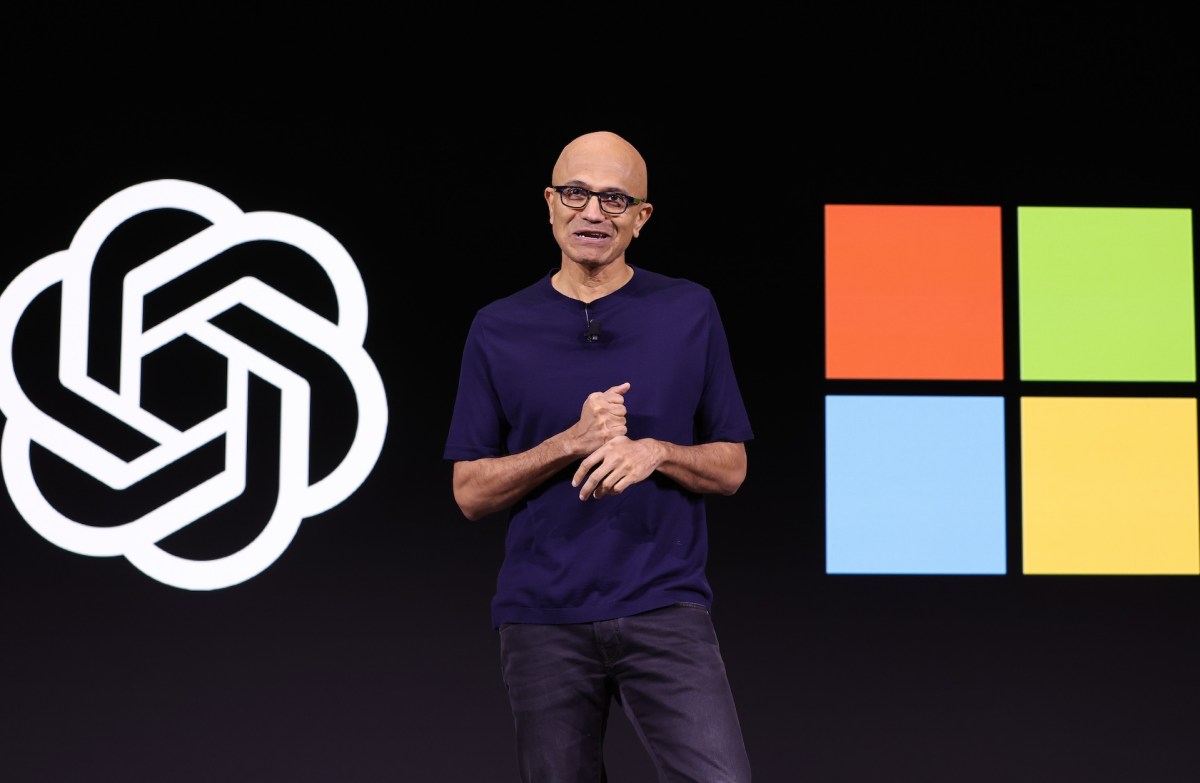
Satya Nadella, the CEO of Microsoft, has joined a growing chorus of voices cautioning enterprises about the hidden costs of using proprietary artificial intelligence models. In a blog post published on Sunday, Nadella warned that companies are effectively paying twice for AI intelligence—once in direct financial costs for token usage, and again by unknowingly handing over their most sensitive business data.
This warning adds to the already heated debate surrounding AI adoption. Venture capitalists like Jason Calacanis and Palantir CEO Alex Karp have previously expressed concerns that AI labs such as OpenAI and Anthropic could act as Trojan horses, gaining access to proprietary information that could later be used against their customers. Now, the CEO of one of the world's largest technology companies has amplified that message.
Nadella's Core Argument: Data as Currency
Nadella's argument centers on the concept of data exhaust. When enterprises use AI models, they not only submit prompts but also provide feedback and corrections, which the models use to improve. Over time, this process teaches the AI about the nuances of a company's operations, strategies, and competitive advantages. As Nadella writes, 'Models learn from 'exhaust,' the prompts people write, the tools agents use, and especially the corrections people make when the model is wrong. Every correction is distilled into institutional know-how.'
He further argues that this knowledge is 'the kind of knowledge a competitor could never buy,' yet enterprises are freely handing it over. The irony, Nadella points out, is that AI labs like OpenAI and Anthropic have trained their models on vast swaths of public data from the internet, often under fair use claims. However, they then impose restrictive terms on customers who wish to reverse-engineer or distill those models. Distillation is the practice of using a model's outputs to train a new, often smaller and cheaper, model. In February 2026, Anthropic accused Chinese open-source models of using massive numbers of prompts to Claude for precisely this purpose, calling for government export controls.
Nadella sees this as hypocritical. 'While the great innovation that comes from model providers having fair use rights to train models on public data is needed, I find it ironic that the status quo is to then turn around and impose restrictive terms on distillation,' he writes.
The Proposed Solution: Ownership and Orchestration
The Microsoft CEO does not simply criticize; he offers a solution, one that naturally benefits his company's cloud business. Nadella urges enterprises to 'retain ownership' of their data, including prompts, feedback, and interaction logs. To achieve this, he recommends building 'proprietary learning environments' on the cloud—where much of their data already resides, and conveniently, could mean Microsoft Azure. He also emphasizes the need for 'orchestration layers' that allow companies to easily switch between different AI models from various providers, avoiding vendor lock-in. This concept has gained traction with the rise of AI gateways, which are tools designed to route requests across multiple models.
Although Nadella never uses the term 'open source,' the subtext is clear: by owning their data and model-switching infrastructure, companies can avoid the risks of proprietary models. This aligns with a broader industry shift. Many large enterprises are already moving toward open-source models hosted on their own premises. Idit Levine, founder and CEO of Solo.io, a company that helps manage AI systems, confirms this trend. Her customers, which include T-Mobile, ADP, and SAP, are experimenting with proprietary models but increasingly asking, 'Can I take an open source model and run it on-prem? It will do almost 90% of what the big one's doing. It will cost way less.'
Solo.io's technology powers the Linux Foundation's Agentgateway project, and Levine sees on-premise open-source models as the next big wave in enterprise AI. Data from other companies supports this. Vercel, a web hosting platform that recently added AI model-switching tools, and OpenRouter, a routing service for developers, both report surges in traffic to open-source models. Last month, open models accounted for 29% of all traffic through Vercel's gateway.
The Microsoft Paradox: Investor and Critic
Nadella's position is particularly striking because Microsoft is a major investor in both OpenAI and Anthropic, two of the largest proprietary AI labs. The company has poured billions of dollars into OpenAI, integrating its models into products like Microsoft 365 Copilot and Azure AI services. Yet, here is Nadella publicly urging enterprises to be cautious about using those very models. This paradox highlights the tensions within the AI ecosystem: even as investors seek returns, the CEOs of those same investors recognize the long-term risks of centralized AI ownership.
The warning also reflects Microsoft's dual strategy. On one hand, the company profits from selling access to proprietary models through its cloud platform. On the other, it wants to position Azure as the backbone for enterprise AI infrastructure, regardless of whether customers use proprietary or open-source models. By advocating for data ownership and orchestration, Nadella is subtly pushing enterprises toward a model-agnostic approach that relies on cloud services—services that Microsoft excels at providing.
Historical context adds depth. Microsoft's earlier experiences with vendor lock-in, particularly in the PC era, have made the company sensitive to the issue. However, critics argue that Nadella's solution is simply a new form of lock-in, this time to the cloud. The 'orchestration layer' itself could become a dependency, especially if built on Azure-specific tools.
Key Facts from the Debate
- Satya Nadella warns that enterprises using proprietary AI pay twice: financial costs and surrender of proprietary data.
- He argues that model makers learn from user feedback and prompts, gaining institutional knowledge that could be used competitively.
- Nadella calls for fairness: AI labs should not restrict distillation while themselves training on public data.
- He recommends retaining data ownership and building orchestration layers to switch between models, implicitly promoting Azure.
- The trend toward on-premise open-source models is accelerating, with companies like Solo.io, Vercel, and OpenRouter reporting increased usage.
- Microsoft's dual role as investor in OpenAI and Anthropic and as a critic of proprietary models creates a strategic paradox.
Industry Responses and Implications
The announcement has sparked reactions across the tech industry. Some applaud Nadella for highlighting the data sovereignty issue. Dr. Sarah Chen, an AI ethics researcher at Stanford, notes that 'Nadella has put a spotlight on a problem that many in Silicon Valley have whispered about but few CEOs have openly discussed. The risk of losing competitive intelligence to AI vendors is real and underappreciated.' Others are more skeptical, pointing out that Microsoft's own Azure AI services collect usage data, though the company claims it does not use customer data to train foundation models.
OpenAI quickly responded with a statement reiterating that it does not use API data for model training without explicit consent, a policy it updated in 2023. Anthropic has similar policies. However, concerns persist that these policies may change or that data could be used in aggregated ways that still reveal insights.
The debate also ties into broader discussions about AI regulation. The European Union’s AI Act, which came into force in 2025, includes provisions requiring transparency about training data, but it does not specifically address the issue of data exhaust from enterprise users. In the United States, the Biden administration's executive order on AI from 2023 encouraged voluntary commitments but stopped short of mandating protections for business data.
As enterprises weigh their options, the allure of open-source models grows. Open-source models like Llama 3, Mistral, and others have become increasingly capable, with performance approaching that of proprietary models in many tasks. Running them on-premise gives companies complete control over their data, but it requires technical expertise and infrastructure investment. For smaller companies, this may be prohibitive, making them more dependent on cloud-based proprietary models despite the risks.
Nadella's intervention may accelerate the shift toward hybrid approaches, where companies use proprietary models for broad tasks but rely on fine-tuned open-source models for sensitive work. The rise of AI gateways and orchestration tools makes this easier, enabling seamless switching based on task, cost, or data sensitivity.
Ultimately, Nadella's warning serves as a reminder that in the AI era, data is not just the fuel for models—it is also the asset that companies must guard most fiercely. As he writes, 'In consuming intelligence, you are creating intelligence. And what you create should belong to you.' Whether the industry heeds that advice or continues to trade intelligence for convenience remains to be seen, but the conversation has undoubtedly shifted.
Source:TechCrunch News