

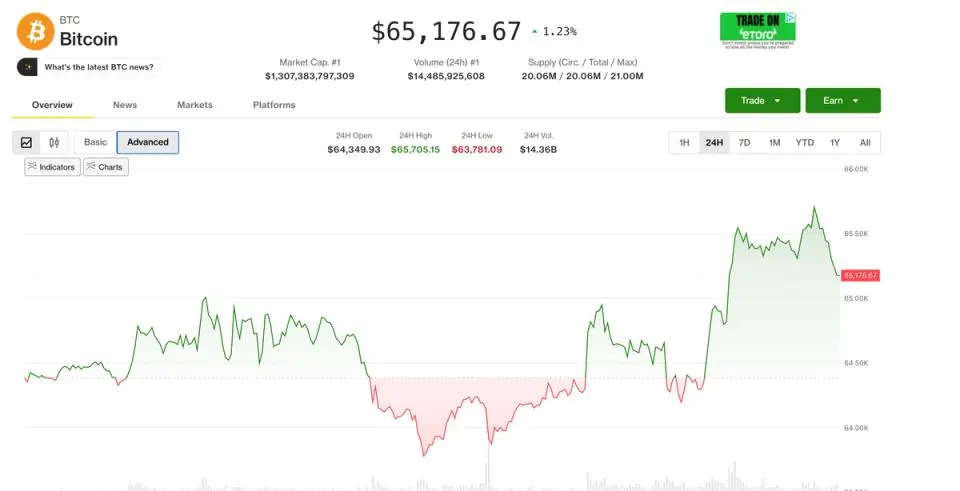
Bitcoin Rally and Pullback
Bitcoin climbed to a one-month high of $65,700 on Monday, July 20, before giving back gains as geopolitical headlines and shifting interest rate expectations weighed on sentiment. The largest cryptocurrency by market capitalization rose above $65,000 in early afternoon trading, only to fall back to around $65,000 by the close of U.S. equity markets. The move came amid a volatile session for stocks and commodities, with crude oil initially tumbling on a report that Iran was seeking to revive ceasefire talks, only to rebound sharply as the report was discredited. Bitcoin's pullback mirrored a broader risk-off shift in the afternoon, with the Nasdaq closing roughly flat after being up more than 1% earlier. The S&P 500 fell 0.15%, and the Dow Jones Industrial Average dropped 0.6%. The 10-year U.S. Treasury yield added five basis points to 4.59%, while short-term rate traders increased the odds of a July Federal Reserve rate hike to 16% and September rate hike odds to 63%, according to CME FedWatch. These macro factors exerted pressure on bitcoin, which remains sensitive to shifts in liquidity and risk appetite.
Macro Factors and Oil Volatility
The day's macro narrative was dominated by oil and interest rates. WTI crude sank by roughly $3 per barrel to below $80 following the early morning Reuters report that Iranian mediators proposed a 10-day ceasefire for talks between the U.S. and Iran. This optimism quickly faded as the report lacked legs, sending WTI crude back to about one-month highs of $82.50. The seesaw in oil prices reflects ongoing geopolitical uncertainty, with Iran and the U.S. engaged in direct strikes that have heightened supply concerns. Brent crude briefly topped $90 a barrel. Meanwhile, the rise in Treasury yields and Fed rate hike probabilities added to a cautious tone, particularly for growth‐sensitive assets like cryptocurrencies. The prospect of higher rates reduces the appeal of speculative assets, and bitcoin's afternoon pullback was a direct reaction to this shifting backdrop.
Crypto Stocks Surge on AI Deals
Amid the broader uncertainty, several crypto-related stocks posted strong gains driven by news of significant AI cloud contracts and data center expansions. IREN (IREN) rocketed 21% to $40.70 after announcing new cloud services contracts valued at $2.8 billion. The company lifted its year‐end AI Cloud annualized ARR to over $4 billion from $3.7 billion, and Cantor Fitzgerald reiterated a $99 price target, citing IREN's access to substantial power and compute capacity. Hut 8 (HUT) also surged 16.7% pre-market after signing a second 15-year lease at its Beacon Point campus in Texas, doubling the existing tenant's capacity to 704 MW and pushing the contract value to roughly $19.6 billion. These developments underscore the growing intersection of crypto mining infrastructure and AI compute services, a trend that has attracted investor attention despite the recent pullback in chip stocks. Galaxy Digital (GLXY) rose 8%, Circle (CRCL) gained 6%, Coinbase (COIN) added 1.5%, and Strategy (MSTR) climbed 3%.
Corporate Bitcoin Accumulation and Capital Moves
Several publicly traded companies active in bitcoin holdings made headlines for their capital management strategies. Strategy (MSTR) disclosed the sale of $263.5 million in common stock last week, with $225 million boosting its cash reserve to $3.225 billion—enough to cover 22 months of dividends on its high-yielding preferred stock (STRC). The company continues to hold 843,775 bitcoin, valued at about $54.3 billion at current prices. Notably, this was the second consecutive week Strategy purchased no new bitcoin, instead using proceeds to shore up cash. Matt Cole's Strive (ASST) added 21 bitcoin last week, raising its holdings to 19,921 coins, while selling 443,797 shares of common stock to raise around $4.5 million. Its cash reserve increased to $157.4 million. BitMine Immersion (BMNR), led by Chairman Tom Lee, added just 7,430 ether tokens—its smallest weekly purchase this year—and repurchased 5.5 million of its struggling shares. BMNR remains down about 50% year-to-date. These moves reflect a strategic shift among bitcoin treasury firms to strengthen balance sheets rather than aggressively accumulate.
Regulatory and Exchange Developments
Crypto exchange OKX announced the appointment of former New York Governor Andrew M. Cuomo to its Board of Directors, formalizing a relationship that began in 2023 when he started advising on U.S. regulatory and institutional strategy. The move comes as OKX expands its U.S. presence and broadens its focus beyond crypto trading into financial infrastructure. Cuomo co-chairs the recently announced OKX and Intercontinental Exchange (ICE) joint venture, which aims to connect traditional and digital financial markets through regulated blockchain infrastructure, subject to regulatory approvals. This venture plans to support tokenized markets and expand institutional access to digital assets. Separately, the tokenization firm Securitize (SECZ), backed by BlackRock, continued its post-listing slump, falling another 8% to around $6.60, roughly 50% below its high after a late‐June debut through a merger with a Cantor‐backed SPAC. No company‐specific catalyst was apparent, and the weakness stood out against a broader advance among crypto stocks.
Altcoin and Token Activity
Smaller tokens posted impressive gains even as bitcoin chopped sideways. In the past 24 hours, meme launchpad Pump.fun’s PUMP token gained over 16%, Pi Network’s PI token rose 12%, and tokens such as JUP, ING, and BEAT gained 2% to 3%. Meanwhile, Provenance Blockchain’s HASH token slipped nearly 10%, making it the biggest loser among the top 100 cryptocurrencies by market value. ZEC, NIGHT, and LIT each fell 3% to 5%. The divergence between large‐cap and small‐cap crypto assets suggests a selective rotation, where traders are chasing niche narratives while bitcoin consolidates.
Earnings and Market Outlook
The week ahead is pivotal for equity and crypto markets, with Big Tech earnings on the horizon. Alphabet reports Tuesday, Tesla on Wednesday, and Intel on Thursday. These results will be read for signs of whether the AI spending boom that powered this year's rally is still accelerating or if last week's volatility has further to run. Chip stocks took a breather on Monday after entering a bear market last week, with the iShares Semiconductor ETF edging higher in premarket trade. Alibaba rallied in Hong Kong after previewing its latest AI model. The interplay between tech earnings, geopolitical tensions, and interest rate expectations will likely continue to influence bitcoin's trajectory, as the cryptocurrency remains correlated with risk assets.
Market Recap and Broader Implications
Bitcoin’s brief spike above $65,700 and subsequent retreat highlights the fragile nature of the current market environment. The cryptocurrency tested and failed at the $65,000 level multiple times since the June crash that took prices down to $58,000. Monday’s action reinforces that overcoming resistance requires a sustained catalyst, such as a dovish Fed pivot or clearer regulatory progress. The Iran ceasefire report initially fueled a rally but proved fleeting, while rising rate hike odds reasserted downside pressure. Meanwhile, the AI compute sector’s gains for companies like IREN and Hut 8 indicate that institutional demand for digital asset infrastructure remains robust. The appointment of Andrew Cuomo to OKX’s board signals continued mainstream integration. However, the underperformance of newly listed crypto firms like Securitize suggests that market enthusiasm for crypto IPOs is waning. Overall, the day encapsulated the complex crosscurrents facing crypto markets: bullish micro stories in corporate adoption and AI compute, but macro headwinds from rising rates and geopolitical unrest.
Source:Coindesk News