

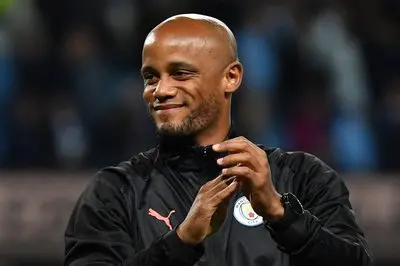
Vincent Kompany, the legendary Belgian international defender, has officially ended his playing career at the age of 34 to assume the position of head coach at RSC Anderlecht. The club announced on Monday that Kompany has signed a four-year contract, transitioning from his previous role as player-manager to a purely managerial capacity. This move marks the culmination of a storied playing career that saw Kompany become one of the greatest defenders of his generation, particularly during his 11-year spell at Manchester City, where he captained the team to numerous trophies.
A Storied Playing Career
Kompany's journey in football began at Anderlecht's youth academy. He made his first-team debut for the Belgian club at the age of 17, quickly establishing himself as a prodigious talent. After four seasons in Brussels, he moved to Hamburger SV in 2006, honing his skills in the Bundesliga before Manchester City signed him in 2008. At City, Kompany became the bedrock of the defense and was appointed captain in 2010. Under his leadership, the club experienced an unprecedented era of success, winning four Premier League titles (2012, 2014, 2018, 2019), two FA Cups (2011, 2019), and four League Cups (2014, 2016, 2018, 2019). He also helped City clinch the Community Shield twice. His iconic performances, including a crucial goal against Manchester United in 2012 and a thunderous strike against Leicester City in 2019, are etched in the memories of fans worldwide.
Kompany's international career was equally impressive. He made his debut for Belgium at just 17, going on to earn 89 caps. He captained the Red Devils to a third-place finish at the 2018 FIFA World Cup in Russia, their best-ever result. However, injuries often plagued his later years, limiting his appearances. Despite persistent muscle problems, Kompany's leadership and tactical acumen remained undiminished.
After leaving Manchester City in 2019, he returned to Anderlecht on a three-year player-manager contract. The aim was to combine coaching duties with occasional playing appearances, but the dual responsibility proved challenging. During the 2019-20 season, Kompany featured in 15 league matches and managed 16 as coach, but results were inconsistent. The club finished eighth in the Belgian Pro League, a far cry from their historical dominance. Franky Vercauteren had been brought in to handle the day-to-day coaching, allowing Kompany to focus on his playing role and longer-term vision. Now, with full commitment to coaching, Kompany aims to restore Anderlecht to their former glory.
The Decision to Retire
Speaking about his decision, Kompany stated: "I want to fully commit to my role as a coach and need 100% of my time and focus for it. That's why I'm quitting as a football player." He emphasized that his ambition and hunger remain unchanged. "I want to stay with the club for at least four seasons and prove that Anderlecht can play a modern style of football, with results." This statement reflects Kompany's desire to implement a progressive, possession-based philosophy similar to the one he experienced under Pep Guardiola at Manchester City. His first test will come on Sunday as Anderlecht take on Mouscron in the Belgian Pro League.
Anderlecht's Recent Struggles
Anderlecht, the most successful club in Belgian football with 34 league titles, have faced a decline in recent years. Since their last championship in 2017, they have finished third, fourth, sixth, and eighth. The club has undergone multiple coaching changes, and financial constraints have made it difficult to compete with the rising power of Club Brugge and Genk. Kompany's return was seen as a beacon of hope, but the player-manager experiment yielded mixed results. Now, as a dedicated head coach, he has the opportunity to build a stable project. Key players like Yari Verschaeren, Albert Sambi Lokonga, and Hendrik Van Crombrugge offer a solid base, but Kompany will need to instill a winning mentality while developing young talent from the club's famous academy.
Kompany's Managerial Philosophy
Kompany has often spoken about the importance of modern football—high pressing, quick transitions, and intelligent positional play. He has been influenced by Guardiola, but also by his own experiences as a leader. At Anderlecht, he has already begun to implement these ideas, though results have been sporadic. "I am not afraid of failure," Kompany once said. "What I fear is not giving everything I have." His appointment as permanent boss signals a long-term commitment. The four-year contract allows him to develop his methods without the immediate threat of dismissal. Anderlecht's board has expressed full confidence in him, and the fans remain hopeful that their former academy product can replicate the success he had as a player.
Beyond tactics, Kompany's greatest asset may be his leadership. He was known at Manchester City for his ability to motivate teammates, command the dressing room, and make crucial defensive interventions. As a coach, he must now impart these qualities to a squad that lacks the star power he once had. He will rely heavily on his experience and the respect he commands across football.
Impact on Belgian Football
Kompany's transition to full-time coaching is significant for Belgian football. He joins a growing list of former internationals who have moved into management, such as Roberto Martinez (currently Belgium's national team coach) and Michel Preud'homme. However, Kompany's profile is unique because of his Premier League success and his young age. Many see him as a potential future manager of the Red Devils. For now, his focus is on Anderlecht. The club's supporters are eager to see a return to attractive, winning football. The pressure will be high, but Kompany's determination and tactical knowledge suggest he is well-equipped to handle it.
Analysis of the First Match
The upcoming fixture against Mouscron offers a chance to gauge Kompany's immediate impact. Mouscron are a mid-table side, and Anderlecht will be expected to win. However, given the team's recent inconsistency, nothing can be taken for granted. Kompany will likely field a strong lineup, perhaps including experienced players like Adrien Trebel and new signings such as Mustapha Bundu. Fans will watch closely for any tactical changes, such as a higher defensive line or more aggressive pressing. This match will be the first step in a long journey, and Kompany is aware of the challenges ahead.
In addition to on-field results, Kompany must manage the transition from player to coach. He will no longer have the option to step onto the pitch and influence games directly. His relationship with the squad will evolve, as former teammates become subordinates. Kompany's leadership skills should ease this transition, but it remains a delicate process. He will need to build a coaching staff that complements his strengths and addresses weaknesses.
Broader Context of Player-Manager Transitions
History is filled with examples of great players who struggled as managers. Legends such as Diego Maradona, Zinedine Zidane, and Pep Guardiola have had varying degrees of success. Zidane's three consecutive Champions League titles are an outlier, but many others have failed to replicate their playing achievements. Kompany's advantage is his intelligence and analytical approach. He has already spent a year learning the ropes as player-manager, with mentors like Vercauteren. Now, he must apply those lessons. Anderlecht's faith in him is a gamble, but one that could pay dividends if he can instill discipline and tactical sophistication.
The Belgian Pro League has seen rising competition, with Club Brugge dominating recent seasons. Anderlecht's storied history means they cannot be written off, but rebuilding takes time. Kompany's four-year deal suggests a patient approach. The club's hierarchy understands that immediate title challenges may be unrealistic, but progress in terms of play style and youth development will be expected. Kompany has already shown willingness to promote young players, and his experience at City's academy—though not directly—will inform his methods.
Off the pitch, Kompany has also been involved in community projects and business ventures. His leadership extends beyond football, and he is seen as a role model in Belgium. His decision to retire and focus on coaching underscores his commitment to Anderlecht and his desire to contribute to the game in a new capacity.
As the Sunday match approaches, all eyes will be on the Anderlecht dugout. Kompany will be managing his first competitive match as a sole head coach. The emotions will be high, but his focus remains clear: to build a team that plays modern, winning football. "Our ambition and our hunger remains the same," he reiterated. For Vincent Kompany, a new chapter begins—one that could define the next decade of his career.
Source:ECR News