

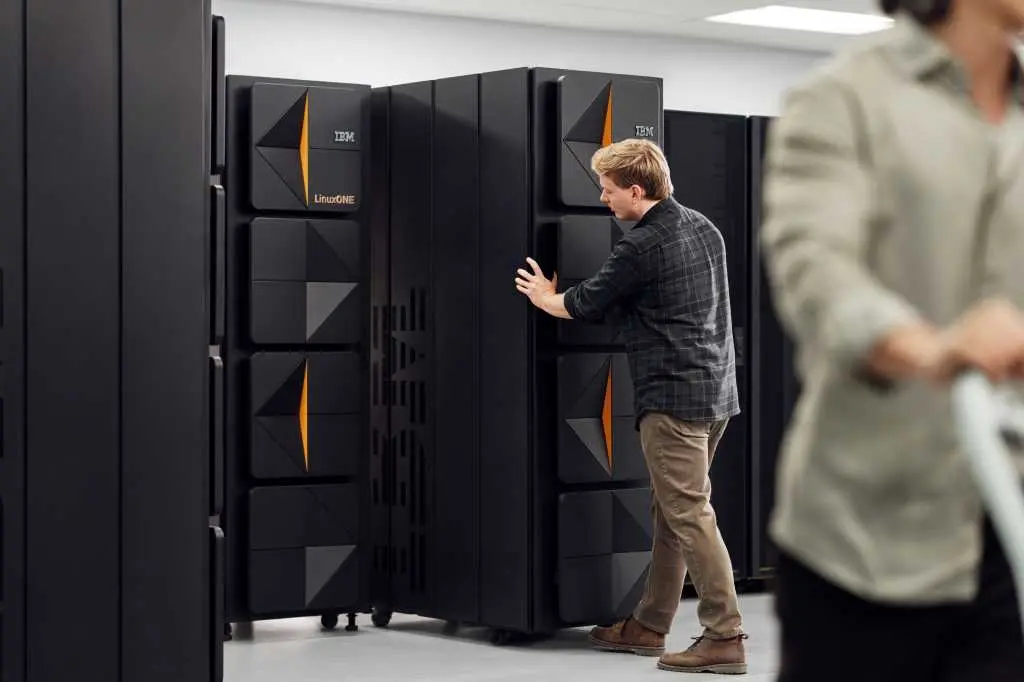
IBM has announced significant expansions to its mainframe portfolio, introducing new single-frame and rack-mount models of the IBM z17 and LinuxONE Rockhopper 5 systems. These additions are designed to bring the security, resilience, and performance of mainframe computing to a broader range of deployment scenarios, particularly those involving artificial intelligence and hybrid cloud architectures.
The new offerings aim to address the growing demand for powerful, compact infrastructure that can support AI inferencing, high-volume transactions, and confidential computing. By offering both fully packaged and customizable form factors, IBM seeks to attract new clients and meet the needs of existing customers looking to modernize their data center operations.
New Hardware Models
The z17 single frame is a fully enclosed unit delivered in an IBM rack with intelligent power distribution, ready for edge deployments. The z17 rack mount allows customers to install IBM Z components directly into their own industry-standard racks, offering flexibility for co-location with other technologies.
For LinuxONE, the Rockhopper 5 is available in both single-frame and rack-mount configurations, targeting high-density Linux workloads. Additionally, the new LinuxONE 5 Express is a preconfigured rack-mount system offering an 18U footprint, designed for organizations that want a cost-efficient entry point with scalability.
All new models support up to 82 cores and 18 TB of memory across two processor drawers, representing a 20% increase in core count and 12% increase in memory capacity compared to previous systems. The single-processor z17 ME2 offers 10% greater throughput per core than the z16 A02.
AI and Security Enhancements
Both the z17 and Rockhopper 5 are powered by the 5.5 GHz IBM Telum II processor, which includes a built-in AI accelerator capable of running over 450 billion inferencing operations per day with millisecond response times. The systems also feature the 32-core Spyre AI accelerator for additional AI workload handling.
Security has been strengthened with post-quantum cryptography now standard on these systems, allowing customers to protect long-lived data against future quantum threats. IBM also introduced Crypto Discovery & Inventory to help security teams identify encrypted assets, and Infrastructure Management for Z and LinuxONE for centralized administration and automation.
These enhancements are part of IBM’s strategy to make mainframes more accessible and manageable in hybrid IT environments, supporting both traditional transaction processing and emerging AI-driven applications.
Market Context and Availability
The mainframe continues to play a central role in enterprise IT, especially for organizations that require high security and reliability. According to a recent IBM Institute study, 75% of executives expect mainframe-based applications to remain crucial to digital transformation, and 60% see mainframes as essential for enabling AI innovation.
Gartner’s 2026 report on the state of the IBM mainframe highlighted that most customers are prioritizing reduction of technical debt and adopting platform innovations to future-proof their environments. IBM’s investment in smaller, more flexible form factors aligns with these trends.
The new z17 single-frame and rack-mount configurations, along with LinuxONE Rockhopper 5 and LinuxONE 5 Express, will be available on August 12, 2026. The Infrastructure Management for IBM Z and IBM LinuxONE will follow on August 14, 2026.
With these launches, IBM continues to evolve its mainframe line, addressing the need for powerful yet compact systems that can support AI, hybrid cloud, and security-intensive workloads in a variety of deployment scenarios.
Source:Network World News